
Star rating: 5 stars–outstanding/potential classic, 4 stars–very good, 3 stars–adequate, 2 stars–disappointing, 1 star–poor.
Whenever I hear a reference to elegance in perfumery, I invariably think of Christian Dior Eau Sauvage, because few existing fragrances are as exquisitely refined as this composition by the great perfumer Edmond Roudnitska. Of course, elegance can be achieved in a number of different ways, but the effortless, streamlined sophistication of Eau Sauvage has an immediate appeal. In many ways, the beauty and the genius of this fragrance lie in its perfect balance: a balance between different elements of the composition, between simplicity and complexity, between artistic merit and pure pleasure. Eau Sauvage is one of those rare perfumes that have plenty to say, but that are easy to understand.
Each era had its own scent, and some fragrances weathered the time better than others. Whenever I smell Eau Sauvage, it is hard to believe that this fragrance will celebrate its 50th birthday in 2016. It possesses the airy, luminous quality that is prized and widely imitated today, and in fact, one of Roudnitska’s contributions to perfumery was the introduction of radiant effects. Considering that Eau Sauvage still remains an important trendsetter in masculine perfumery, it is not surprising to discover that many citrus-herbal blends, from Nina Ricci Signoricci 2 to Carolina Herrera 212 Men, pay tribute to it.
Classicism and Avant-Garde
The effervescence of Eau Sauvage is set by bergamot, lemon and basil, which form an exhilarating prelude. The classical cologne idea behind Eau Sauvage can be seen in an earlier Roudnitska creation, Christian Dior Eau Fraîche (1953,) where the orchestration of citrus, bright green herbs and violet tinged woods has a springtime freshness. Compare Eau Fraîche to Eau Sauvage, and suddenly something becomes very obvious—for all of its brightness Eau Sauvage has a subtle, but distinctive animalic undercurrent. And while you are comparing Eau Sauvage to Eau Fraîche, pull out a bottle of Diorella. A few years later in 1972, Roudnitska elaborated Eau Sauvage’s idea to make an even more sensual composition built around the same fresh, watery concept.
Eau Sauvage is often mentioned as the first fragrance pioneering the use of the lemony jasmine note of hedione. In fact, hedione is used in only trace amounts in Eau Sauvage, in contrast to most fragrances today that use it in much higher proportions. While hedione gives a novel airy quality to Eau Sauvage, it is not what makes this fragrance special. The most magical part is the perfect harmony between the disparate elements that result in an original and beautiful impression. Much like Monet’s wide strokes of green, purple and orange magically produce a vision of a bridge over a lily filled pond, the citrus, bitter herbs, and damp woods of Eau Sauvage evoke the crisp white shirt and warm skin of someone irresistibly attractive.
Eau Sauvage Today
The seductive timbre of moss and the indolic twist of jasmine that give Eau Sauvage its deliciously dark facet have been reduced in the current version, along with the clove like warmth in its heart. Today, it is closer to a classical citrus cologne, and the warm skin sensation that I loved about Eau Sauvage is not as obvious. Nevertheless, I still find Eau Sauvage an excellent fresh citrus fragrance, and although it is marketed to men, women should explore it, especially if they enjoy Jean-Claude Ellena’s colognes for Hermès.
Eau Sauvage also has two siblings, which occasionally show up on Ebay and various discounters at bargain prices. Eau Sauvage Extrême (1984) is a richer citrus blend, with dark amber notes lacing the drydown. Also, the floral twist is more honeyed as compared to the lemony jasmine brightness of the original. Eau Sauvage Fraîcheur Cuir (2007, now discontinued) was an interesting leather dominated interpretation of Eau Sauvage, with iris and warm spices lending it a velvety effect.
Christian Dior Eau Sauvage contains notes of lemon, petitgrain, rosemary, jasmine, lavender, basil, hedione, vetiver, andoakmoss. Available from most retailers and Christian Dior boutiques.
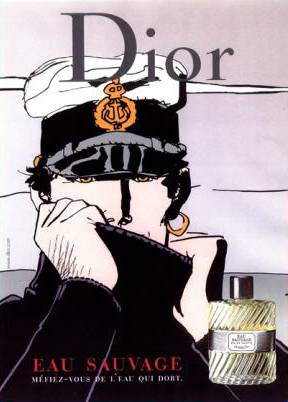
Image: Dior Eau Sauvage, Corto Maltese.
Sample: I’ve compared several versions of Eau Sauvage from the 1960s, 1970s and 1980s with the fragrance sold at Saks5thAvenue Dior counter today.






















33 Comments
Suzanna: This review is a triumph in perfume writing, V.
Not only is ES a classic, so is the advertisement using the Corto Maltese sailor. The ad could easily have appeared in any decade since ES’s creation and still be powerful. Contrast with the cheap shots across the sexual bow taken by Tom Ford and Marc Jacobs. November 8, 2011 at 8:55am
Victoria: Thank you, Suzanna! Writing about classics is intimidating sometimes–so many stories, so many details… And reformulations, of course!
I completely agree, this is one of my favorite ads. November 8, 2011 at 11:51am
Marcin: Great review of a great perfume which I adore! Thanks! November 8, 2011 at 12:27pm
Victoria: You are welcome! It is truly one of the best. I like it in all versions. November 8, 2011 at 2:00pm
carmencanada: Eau Sauvage is truly an absolute point of reference, isn’t it? The original formula just awes me with its perfection. When I present it to my young, mostly American fashion students (who, unlike young French people, might not have smelled it on their elders a million times), they’re absolutely conquered. Which goes to show you can take any Vera-Wang-Princess-loving young lady, present her with utter beauty, and she’ll get it. November 8, 2011 at 2:05pm
Victoria: In the perfumery school, Eau Sauvage was my favorite fragrance to duplicate. It is just amazing how it is put together.
Your story is great, and a perfect testament to the fact that despite whatever the marketing leads us to believe, people recognize quality products. November 8, 2011 at 3:13pm
Bert: Care to share the composition? I’d love to make my own. February 10, 2014 at 3:42pm
carmencanada: These young women walked out talking about Eau Sauvage, Cuir de Russie, Mitsouko, La Treizième Heure… In fact, when I get a group of fashion students for a mini-historic tour of the Palais-Royal area, ending with Serge Lutens, several end up buying. And I always hear at least once or twice: “I never knew perfume could be this.” Not only does that make me feel my mission is accomplished, but convinces me that, as you say, it doesn’t take much for people to recognize beautiful perfumes once they’re exposed to them. November 8, 2011 at 5:01pm
Lindaloo: Thanks for this review and, especially, for the comparison to today’s version. I hope that you will sometime soon undertake a similar review of Diorella as you have identified it as one of your top 5. One of mine too. I get some sense of your thoughts from your hedione article, but I wait for a full treatment. November 9, 2011 at 2:06am
Victoria: Doesn't it feel so good? I always love introducing people to quality fragrances. Speaking of perfume boutiques, I loved your recommendation of Sens Unique. What a great store! November 8, 2011 at 9:48pm
Nikki: Wonderful review! Your beautiful writing made me go to the fridge and take out my eau sauvage, spray it on while cooking chanterelle with cream sauce…Now I have to look for Eau Sauvage Extreme! Thank you… November 9, 2011 at 11:34am
Victoria: I will do! It has been on my to-review list for a while. Diorella is such a remarkable fragrance. Fresh and bright, but with a seductive ripeness about it. November 9, 2011 at 9:17am
Victoria: What a coincidence! I'm working from home today, and that's what I'm making for lunch. Will have them on toast. Mushrooms almost rival chocolate as my favorite food. 🙂
The other versions don't compare to the original Eau Sauvage, but they are very good. November 9, 2011 at 11:38am
Nikki: I know, Victoria, mushrooms are absolutely divine…I can’t get enough of them. I spent some time in Piemonte, Italy during the truffle season and ate lunch at Belvedere La Morra restaurant where huge white truffles were shared among the guests to grate over their pasta (it was a private celebration). I have never smelled anything like this before, it was heaven….Chanterelles are in season now, they are bigger than the ones we have in Europe and not as tasty but they will do…I do like the marinated mushrooms as well which I buy at the Ukrainian store here with brown bread. There is a mushroom/tubereuse perfume somewhere I read about it. November 9, 2011 at 6:09pm
Victoria: Cepes and Tuberose by Aftelier! It is dark, dense and earthy.
Chantrelles I got from Whole Foods are huge! Unfortunately, they don't have that lovely apricot flavor I love in tiny chantrelles. Still, it was a treat. November 9, 2011 at 7:09pm
Nikki: Thank you, will check out Cepes and Tuberose! November 10, 2011 at 1:29pm
Bert Keuken: Nice review of Eau Sauvage, Victoria. I sampled Eau Sauvage a couple of times last year and must say it really grew on me. So when in France I did like the French have been doing since 1966 and bought myself a 100ml bottle of Eau Sauvage. Lovely stuff, works really well in the heat of summer too. Eau Sauvage recently had another sibling in the form of Eau Sauvage Parfum, but there’s another little known one.
Eau Sauvage 100% Glacon (AKA 100% Cooling Effect) is a limited edtion release from 2001. It’s a kind of summer version of Eau Sauvage. How does it smell? Well there’s menthol and good old Eau Sauvage further down the road. I believe it’s closer to vintage versions of Eau Sauvage than the current Eau Sauvage on offer from Dior. I bought the last two 200ml bottles (cheaply!) from a Portugese webshop.
I’m curious to know what Dior will do on its 50th birthday in 2016. I’m hoping they will re-release Eau Sauvage in its original formulation with a big warning label on the box stating that using it is on your own risk. I’d buy and use it regardless… March 8, 2013 at 8:20am
zari: I’m not sure if you’ll see this – but I am wondering if your review is for the EDP or EDT. I am testing both out, and am wondering which you’re referring to. So far I like both, but the EDP is a little more “masculine” then I’d like to smell. The EDT is what I’m assuming you are describing. Thanks! June 25, 2013 at 4:08pm
Victoria: Yes, you’re right, I’m talking about the EDT. June 25, 2013 at 5:19pm
zari: Oh, I’m so loving it. It’s very hot in the NYC area today, and the beginnings of this edt is perfection and the drydown is so far just too sexy. Thanks for clearing that up for me Victoria! June 25, 2013 at 6:35pm
Kathy: What women’s fragrance is most like the men’s Eau Savage? July 9, 2013 at 11:13pm
Victoria: Christian Dior Diorella for sure! July 10, 2013 at 8:02am
Ferris: Has the oakmoss been removed in the current formulation of Eau Sauvage? I smelled it a few weeks ago and it was very weak to my nose. July 26, 2013 at 5:02am
Victoria: It was definitely toned down. July 26, 2013 at 2:46pm
eminere: Hello, have you smelt Eau Sauvage Parfum? August 22, 2013 at 8:54am
Victoria: Very briefly on paper. I liked it just fine, and I suspect that anyone who likes the original Eau Sauvage will enjoy it. August 22, 2013 at 9:57am
Farnas: What happened with Eau Sauvage?I wore it for years and tried yesterday a new formulation-Longevity doesn’t exist,composition thiner than ever.Do you know what they have done to this masterpiece?I can not believe it.. March 11, 2015 at 5:04pm
Victoria: Yes, it has been reformulated many many times for the past 10 years, if not longer. March 12, 2015 at 1:20pm
Steve L.: Talk of reformulations piqued my interest and motivated me to test some Eau Sauvage. It’s a fragrance I haven’t experienced for years (maybe, ugh, decades). I sure can’t say it’s exactly the same — but it gives an awfully darn good impression. Indeed, it is so reminiscent that it tripped aroma-based memories and transported me to another place and a different, now distant time, in the uncanny way only scent can. Good enough for me. Bought a bottle. August 19, 2016 at 7:14pm
Victoria: I also find that it’s close enough, and the quality is still excellent. Well, nothing stays the same, especially perfume, which depends on crops, weather, politics, etc. I wear Eau Sauvage happily, in whatever version I can find it. August 20, 2016 at 4:36am
john: I’d just like to chime in to say that I bought my first bottle of Eau Sauvage in 2014 and was delighted with it. I’ve gone through three more bottles since then, one of which was an earlier formulation (2009) with oakmoss on the ingredients list. Oddly enough, it was a little weaker (and definitely less ‘sparkling’) than the other bottles, all of which were distinguished by the magnetic cap and slightly lighter colour indicative of François Demachy’s 2011 reformulation & relaunch (you might remember seeing the new advertisements with a vintage yet cigarette-less Alain Delon?) Anyway, the net result is good news, especially when one worries that perfumery is in decline. I’d even swear I smell a little oakmoss in the new version, which makes me wonder what Dior is using in the ‘chypre accord’ cited in their website’s press. This, along with the fact that my bottles of ES seem to deepen as they age more than other things I wear, is one of those little mysteries that makes this fragrance more than the sum of its parts. October 16, 2016 at 2:10am
Farnas: I must share the newest experience with Eau Sauvage.I was well aware of the tragedy that has been done by reformulations, but i smelled Eau Sauvage yesterday and tested it properly only to find that the new formulation is closer than ever to the original, but the weakest in duration and sillage.It is a shame, because the smell again has that slightly dark, mossy undertones and that warm skin effect you were talking about..Well, at least the smell is closer to the original, but i am still sticking with Pour Monsieur de Chanel, has the same emotional effect on me, but with much better performance… July 26, 2018 at 2:47am
mike: Terre d’Hermes has something similar with Eau Sauvage…I don’t know what. May 31, 2021 at 9:22am