Delving into Archives
There are times when perfume acts as a magic carpet for a travel in time, and then there are moments when research leads one into the dank archives of the past. Thanks to the passionate and generous work presented on Scented Pages, a website everybody with at least a passing interest in perfume needs to visit, I had a chance to discover a rich bibliography on all aspects of fragrance. From science and history to specific perfume houses, the website presents an impressive range of literature.
The exploration of the bibliography led to the discovery of several fascinating New York Times newspaper materials, which are available from the New York Times archives. Thus, an article from 1871 surmises that New Jersey might become the next Grasse. Another article from 1929 discusses the new perfume releases that would be appropriate as Christmas gifts. The article I pounced on immediately is titled The Twenty “Noses” of France, written by Donald William Dresden, 1947, because it is usually rare to see the perfumers in the spotlight.
I’ll note, however, that the article is irksome, even if I keep in mind the social context of the times. Here is one such illustration. “Only a few people have the supersense of smell necessary to become a Nose—for reasons known only to Noses themselves, no woman has ever had it—and still fewer the patience and emotional attitude to undergo the required training…” Clearly, Dresden forgot about Germaine Cellier of unforgettable Bandit (1944) and Vent Vert (1947). Moreover, research demonstrates that a woman’s sense of smell is more acute than a man’s, with its acuity positively influenced by the levels of estrogen, the levels of which change throughout the menstrual cycle, with the highest levels recorded in the first half (Nature Neuroscience, March 2002).
The rest of the article is such a riot that I almost forgave its chauvinism. I cannot help sharing some particularly memorable bits. You’d be interested to know that the Nose has certain characteristics, which the writer describes in the social Darwinist terms. “As befits his station, the typical Nose is an imposing looking man. Generally he is middle-aged with fine graying temples or just the right amount of baldness to indicate that he had made his way in life.” If one may wonder, Dresden assures that “the nasal formation is not unusual.” However, “he has lofty brow and features of the intellectual and an air of dedication verging on absent-mindedness.”
And how about this imagery? “Here in Grasse it is commonplace to see a parfumeur créateur pacing slowly under the plane trees in the courtyard of an old, rambling perfume factory, sniffing meditatively at one or more of these strips of paper. A deep concentration wrinkles his brow and his demeanor reminds one of a Wall Street banker studying the pros and cons of a big loan or of a diplomat weighing a delicate démarche.”
A reader may ask an obvious question, why are there only twenty Noses in France? The author explains that the amount of dedication and the inborn talent required weed out quite a few people. “For that reason they are only twenty Noses in France, and this world-famous perfume center is their natural habitat.” None of the names are mentioned, nor are their perfumes revealed, thus, we are left to guess as to the identity of any of these Noses, and appropriately so, given the air of mystery Dresden attempts to create.
The Twenty “Noses” of France by Donald William Dresden. New York Times, December 28, 1947, pg. SM10.
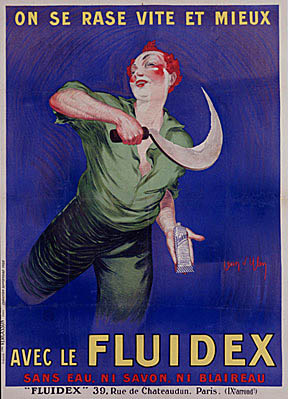
Picture: French vintage advertising poster for a shaving cream from 1922. It does not relate in any way to the topic of my article, however a flying clown with a sickle appeals to my idiosyncratic (and at times sophomoric) sense of humour.