Olivia Giacobetti : Perfumer

Speaking of the Post-Impressionists, Roger Fry, a well-known English critic noted that they did not merely intend “…to imitate form, but to create form…. [not] to imitate life, but to find an equivalent for life… In fact, they aim not at illusion but at reality.” The same can be said about Olivia Giacobetti’s creations, with their marvelous precision combined with dream-like expression. The fig leaf, the iris blossom and the scent of Chinese tea are not just perfect renditions of these scents as found in nature, but they attain a whole new layer of light and movement that cannot be captured merely by reproduction. Experiencing Olivia Giacobetti’s fragrances is like starring at the bright light through gauze, with the sharpness and burning sensation muted, while the glow is more underscored. Her approach is not so much minimalist, as focusing on the essential, whether she is trying to ornament a lilac note or present a milky sappiness of a green fig.
Olivia Giacobetti was born on April 9, 1966 in Boulogne, France. Her father, Francis Giacobetti, a well-known photographer and a director of film Emmanuelle 2, encouraged Olivia in her desire to become a perfumer. At 17, she started studying at Robertet, and several years later she created her own company Iskia.
Her creations
L’Eau del’Artisan for L’Artisan Parfumeur (1993)
Premier Figuier for L’Artisan Parfumeur (1994)
Thé Pour Un été for L’Artisan Parfumeur (1996)
Drôle de Rose for L’Artisan Parfumeur (1996)
Philosykos for Diptyque (1996)
Ofresia for Diptyque (1996)
L’Eau du Fleuriste for L’Artisan Parfumeur (1997)
Navegar for L’Artisan Parfumeur (1998)
Hiris for Hermès (1999)
Ofrésia for Diptyque (1999)
Dzing ! for L’Artisan Parfumeur (1999)
Passage d’Enfer for L’Artisan Parfumeur (1999)
En Passant for Editions de Parfums Frederic Malle (2000)
Fleur de Carotte for L’Artisan Parfumeur (2000)
Tea for Two for L’Artisan Parfumeur (2000)
Thé des Sables for L’Artisan Parfumeur (2001)
Un Bouquet en Mai for L’Artisan Parfumeur (2001)
Opôné for Diptyque (2001)
Andrée Putmann Préparation Parfumée (2001)
Iunx for Shiseido (2003-2004)
Jour de Fête for L’Artisan Parfumeur (2004)
Costes (with Rami Mekdachi)
Cinq Mondes Eau Egyptienne(2005)
Extrait de Songe for L’Artisan Parfumeur (2005)
Le Petit de Guerlain for Guerlain (2005)
Idole de Lubin
Candle for Bottega Veneta, Essence of John Galliano candle for Diptyque, Costes candle
As Giacobetti says about creation of perfume, perfume is a mystery, “a language, a world of symbols which touches the unconscious, a mode of communication that is both emotional and fundamental” (Interview with Olivia Giacobetti). She is inspired by everyday things in creating her fragrances, the scent of quince, fig tree. “Traveling is how I find my sources, I’ve broken the bark of a yellow wood that smelled like quince, gathered sand with a sweet scent I’ve never smelled elsewhere, and even stolen incense from a temple so as not to forget it” (Frederic Malle’s interview). Emotional response is what happens upon experiencing the scent, with the analysis taking place afterwards. When asked about her most mystical perfume, she responds that although she was baptized when she was 10 years old, she did not have religious upbringing. At the same time, she loves the scent and the peace of the church. Her most mystical perfumes are those that are not deliberate. Iunx L’Ether Eau de Parfum and L’Eau Baptiste, an orange blossom scented fragrance water, are the fragrances she names.
My first introduction to Olivia Giacobetti was through L’Eau du Fleuriste, a 1997 limited edition fragrance from L’Artisan Parfumeur. Its combination of mint, rose, cucumber, violet leaves, camomile and beeswax created a beautiful floral that conjured images of a traditional florist shop, where the scent of stem cuttings mingles in the air with the scent of newly delivered flowers. Its sheer interpretation combined with a unique radiant quality led me to discover other Giacobetti creations that surpassed even L’Eau du Fleuriste in my mind. While Giacobetti is an expert at interpreting the scent of rain on flowers and sunshine on leaves, her more daring creations such as Dzing! and Tea for Two are just as interesting. Delicate precision and misty radiance are executed perfectly, whatever theme she undertakes, and this fingerprint marks all of her perfumes.
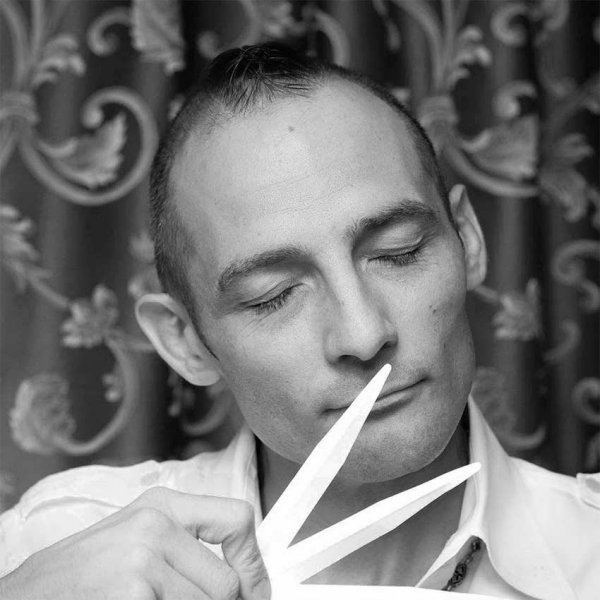
Photo: L’Express.fr.