Cedarwood: 32 posts

Ormonde Jayne Isfahan Pour Homme : Fragrance Review

44444

Isfahan

Star rating: 5 stars–outstanding/potential classic, 4 stars–very good, 3 stars–adequate, 2 stars–disappointing, 1 star–poor.

The first impression of Ormonde Jayne Isfahan is a transparent sizzle of pepper, which has an interesting violet-like sweetness supported by warm citrus notes. The blast subsides quickly, with the bits of pepper dissolving into what is to become the main edifice of the composition—smooth, languidly sweet cedar, with a distinct dark coolness of vetiver. The changes that take place subsequently are few, with the composition having more of linear quality than other Ormonde Jayne fragrances.

Even if Isfahan (2006) pales in comparison to other Ormonde Jayne’s creations, it nevertheless possesses a certain charm that would make this fragrance more appealing on a man than a large number of bland masculine fragrances on the market. On the other hand, it has a sweet softness that would make it appealing for a woman as well. I would have endorsed it stronger had it possessed better tenacity, beyond a mere hour that it lasts on me.

Photo: Si-o-Seh Pol, Bridge of 33 Arches, Isfahan, Iran. One of the most famous Isfahan bridges, it was commissioned in 1602 by Shah Abbas I. There is a famous tea house among the pontoons, upon which the bridge is built.

Serge Lutens Bois et Fruits : Fragrance Review

44444

Caravaggio28

Star rating: 5 stars–outstanding/potential classic, 4 stars–very good, 3 stars–adequate, 2 stars–disappointing, 1 star–poor.

In one of his most famous poems, Alexandr Sergeevich Pushkin, a revered Russian poet, remarks upon the nostalgic autumnal beauty. The beauty that is poignant because of its evanescence. The serene silence pervading the atmosphere forebodes fragile frosts turning into the dense snows of winter. The vibrancy of the gold over crimson foliage hints at the decay about to envelop it. The scents of chrysanthemums and late roses intoxicate as the flowers rush to bloom before the chill.

Chris Sheldrake and Serge Lutens’s Bois et Fruits (1992) captures a moment of autumn before one becomes aware of its farewell connotations. Warm cedarwood is folded over lusciously ripe fall fruits—figs, peaches, and plums, which speak more of a voluptuous aspect of autumn than of its nostalgic side. This fragrance is one of few instances when fruit is not rendered as treacly and artificial. Instead, sweet resinous cedar married to fruit results in a very elegant scent with the brightness of sweet-sour plum courting the soft powderiness of fig.

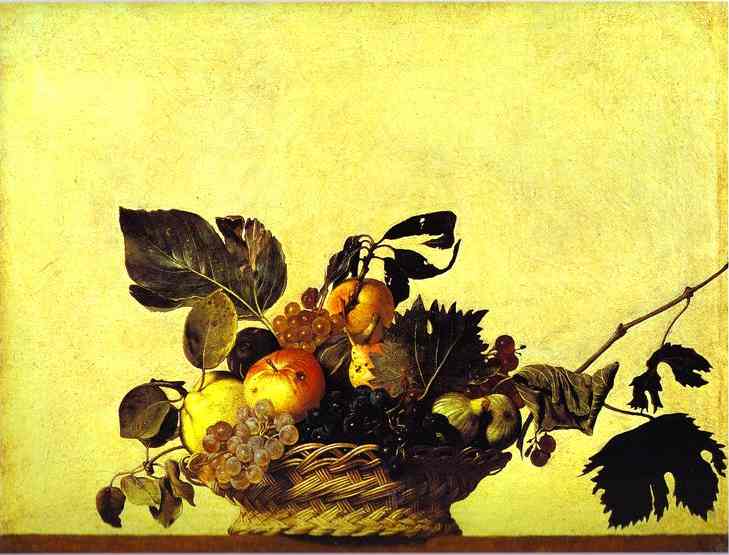
Painting (click to enlarge): Caravaggio, Still Life with a Basket of Fruit. 1601. Oil on canvas. Pinacoteca Ambrosiana, Milan, Italy. abcgallery.com.

Serge Lutens Bois et Musc : Fragrance Review

44444

From_shiseido_ad

Star rating: 5 stars–outstanding/potential classic, 4 stars–very good, 3 stars–adequate, 2 stars–disappointing, 1 star–poor.

My appreciation of most musks is much more theoretical than practical, with Muscs Koublaï Khän being the ultimate sensual animalic musk. Serge Lutens Bois et Musc (a 1992 Chris Sheldrake creation) is a much more restrained fragrance, pairing vegetal musk with Atlas cedarwood. Like Muscs Koublaï Khän, it is sweet and animalistic, however cedar softens the musky notes and lends a satiny counterpoint. Whereas Muscs Koublaï Khän is a Luis Buñuel film, shocking and erotic, Bois et Musc is a much softer take on the sensual aspect of musk. It has an interesting quality of appearing much more innocuous than it really is by starting out gently sweet and smooth and then revealing its more animalic side in the drydown. Perhaps, not as innovative as Muscs Koublaï Khän, but more wearable for me.

Photo: Serge Lutens photography for a Shiseido ad.

Serge Lutens Bois de Violette : Perfume Review

55555

Swan_lake_photo

Star rating: 5 stars–outstanding/potential classic, 4 stars–very good, 3 stars–adequate, 2 stars–disappointing, 1 star–poor.

Chris Sheldrake and Serge Lutens created Bois de Violette in 1992, inaugurating the stint of Serge Lutens as a leading figure of the perfume line for Shiseido at Les Salons du Palais Royal. There is a tendency both to relegate cedar to the masculine, while violet to the feminine domains. One is sharp, resinous and potent, another is soft, modest and sentimental. Yet, Bois de Violette blurs these conventional distinctions so effectively that it cannot but be appreciated for this reason alone. Of course, the ingenuity and the beauty of the composition is another reason to sample this fragrance.

The top notes settle into a mélange of violet leaves with their fresh cut grass scent and soft white cedar, which gradually allows a clear violet note to appear. At first, it is just a glimpse of violet, misted over by sweet and resinous notes, however, the adagio of violet gathers force and takes the center stage. Cedar in Bois de Violette acts like corps de ballet in Marius Petipa choreographed pieces, in which dancers in the background hold same poses for long stretches of time, with minor permutations, thus providing an essential backdrop, without which the ethereal beauty cannot be achieved. The violet is sweet enough to temper resinous notes of cedar, while cedar, in turn, prevents it from becoming a confection-type or powdery violet. It stays close to the skin, creating an olfactory vision of opalescent silk.

Photo: Swan Lake by St. Petersburg’s Ballet Theater. arts-world.co.uk. Swan Lake is an example of classical Petipa choreography.

Cedarwood : Perfume Note

God gave Solomon wisdom and very great insight, and a breadth of understanding as measureless as the sand on the seashore… He described plant life, from the cedar of Lebanon to the hyssop that grows out of walls. 1 Kings 4:29, 33.
Since Biblical times, cedar of Lebanon (Cedrus libani) was among the most prized for its scent properties. Indeed, as Morris notes, Lebanon comes from the Akkadian word lubbunu, which means incense (55). Besides being used in incense blends, cedar was a wood of choice of the aromatic architecture reserved for palaces and temples. Sargon II (722-705 B.C.) used it for his Khorsabad palace, while King Solomon selected cedar for the construction of his temple.

My first encounter with the scent of cedar was through a couple of sticky cones my father brought from Siberia, where he unsuccessfully tried to hit the gold mine by working in the diamond industry. They rattled when shaken and contained small seeds. I remember keeping the cones in a small box, which eventually became permeated with their sweet resinous scent. Every time I would open it, I envisioned tall cedar trees of Siberian forests cloaked in white snow that protected its domain from adventurers like my father.

In perfumery, there are several main sources of cedarwood oil, not all of which are technically cedar. Atlas cedar (Cedrus atlantica) is steam distilled from the wood of an evergreen cedar tree. However, Virginia cedarwood (Juniperus virginiana) and Texas cedarwood (Juniperus mexicana) are not actually cedar trees, but junipers, both of which are related to a plant (Juniperus communis) that yields juniper berry used for flavouring gin (Morris 243). Virginia cedarwood oil is softer and less balsamic than Atlas cedarwood. The conifers’ needles can also be expressed for their oil, which is very inexpensive and is commonly used in soap manufacturing. The precious cedar of Lebanon is no longer felled for its oil as it has become endangered.

Cedar bears a distinction of one of the most frequently used base notes. If presented in moderation, it rounds out sharpness of spice and incense notes, grounds sentimental florals and adds interest to more transparent accords, without compromising their clarity. It is often encountered in fragrances intended for men, since it combines particularly well with citrus notes, the top notes of choice in many masculine fragrances. Given the potential of cedar, it is no wonder that some perfumers like Chris Sheldrake are particularly fond of it and incorporate cedar marvelously in their compositions. My interest in cedar was revived after I encountered Serge Lutens Boix range, which includes cedar variations on violet, spice, musk and autumnal fruit themes. Although cedar is an effective insecticide, mothball associations are usually indicative either of mediocre quality cedarwood or of wrong ornamentation. Testing several types of different cedarwood oils I found the scents to range from smooth and voluptuous, with sweet resinous edge, to sharp and balsamic, with distinct naphthalene smell.

In aromatherapy, cedar is said to encourage confidence and calm anxiety. Perhaps, it is one of the reasons why Japanese baths have such a wonderful effect. The cedar lining of the traditional Japanese bathrooms emanates the sweet balsamic scent, which combined with the steam makes for a true relaxation. It is this experience that inspired Olivia Giacobetti’s Iunx L’Eau Sento No.2.

Perfumes dominated by cedar: Armani Privé Bois d’Encens, Donna Karan Black Cashmere, Iunx No. 2 L’Eau Sento, Ormonde Jayne Isfahan Pour Homme, Parfums 06130 Cèdre, Serge Lutens Cèdre, Serge Lutens Bois de Violette, Serge Lutens Bois et Fruits, Serge Lutens Bois et Musc, Serge Lutens Bois Oriental, Shiseido Féminité du Bois.

Perfumes containing cedar (this is hardly an exhaustive list, and I welcome additions of your favourites): Agent Provocateur, Caron Parfum Sacré, Caron Alpona, Caron Fleurs de Rocaille and Fleur de Rocaille, Caron N’Aimez Que Moi, Caron Pois de Senteur, Caron Royal Bain de Champagne, Caron Tabac Blond, Chanel Cuir de Russie, Diptyque Opôné, Guerlain Chant d’Arômes, Comme des Garçons Sequoia, Guerlain Eau De Fleurs De Cedrat, Hermèssence Poivre Samarcande, L’Artisan Parfumeur L’Eau du Caporal, Ormonde Jayne Osmanthus, Ormonde Jayne Ormonde Woman and Ormonde Man, Ormonde Jayne Frangipani Absolute, Parfums de Nicolaï Pour Homme, Rochas Tocade, Serge Lutens Chêne, Serge Lutens Miel et Bois, Serge Lutens Arabie, Serge Lutens Cuir Mauresque, Serge Lutens Douce Amère, Serge Lutens Iris Silver Mist.

References: Lawless, Julia. 1992. The Encyclopedia of Essential Oils. Element Books, UK. Morris, Edwin T. 1984. Fragrance: The Story of Perfume from Cleopatra to Chanel. E.T. Morris and Co., New York.

Picture: Cedar of Lebanon from en.arocha.org/plants.

As Seen On

Design by cre8d
© Copyright 2005-2026 Bois de Jasmin. All rights reserved. Privacy Policy