i love aldehydes: 20 posts

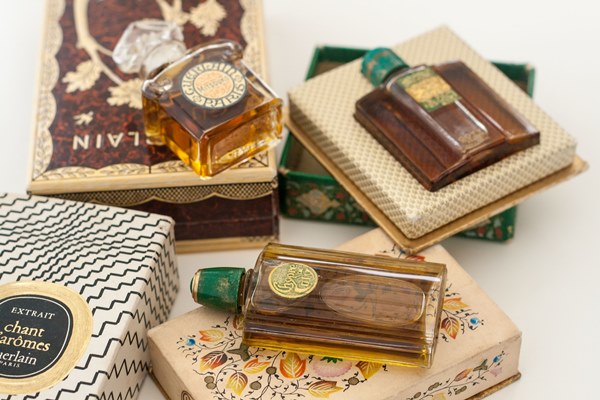
Aldehydes are the aroma-molecules present in orange rind, rose, and cinnamon bark, and their scent ranges from waxy to citrusy, from starchy to green. They can smell like champagne fizz, ironed linen, the white part of citrus rind or even dirty hair. The most famous aldehydic perfume is Chanel No 5, and few other notes spell retro as quickly as a blast of aldehydes. It’s a love or hate effect, but if you love it, below you can find many fragrances that explore these fascinating materials.

Lanvin Arpege New and Vintage : Perfume Review

55555

Arpege_30

Star rating: 5 stars–outstanding/potential classic, 4 stars–very good, 3 stars–adequate, 2 stars–disappointing, 1 star–poor.

Among the fragrances André Fraysse created, none can rival Arpège, which the perfumer composed in 1927 for the French couturier Jeanne Lanvin, in collaboration with Paul Vacher.  Scandal (1932), Rumeur (1932), and Pretexte (1937) followed after the success of Arpège. Jeanne Lanvin dedicated Arpège to her musician daughter, Marie-Blanche, who picked the name for the fragrance.

The original 1927 formulation of Arpège is true to its name–a musical concept of arpeggio–in a sense that individual notes are played distinctly one after another instead of simultaneously. Rose dusted by opalescent aldehydic shimmer unfolds first, followed by rich jasmine.

Continue reading →

Balenciaga Le Dix : Fragrance Review

44444

Le_dix_2

Star rating: 5 stars–outstanding/potential classic, 4 stars–very good, 3 stars–adequate, 2 stars–disappointing, 1 star–poor.

The breeze entering the windows suddenly brings a scent of something bittersweet and sharp. A wave of melancholy overcomes me as I noticed the yellowing leaves and the chill that forebodes the change of seasons. I want to hold onto the time as it passes, and the best way to do so is to envelop oneself in a fragrance that speaks of another era.

Created in 1947 by Francis Fabron, the perfumer responsible for such fragrances as the original 1957 version of Givenchy L’Interdit, Monsieur de Givenchy, and Nina Ricci L’Air du Temps, Balenciaga Le Dix is like a beautiful vintage dress that has lost none of its splendor, despite the passage of time. In fact, time only adds to its beauty.

Continue reading →

Menard L’Eau de Kasaneka : Perfume Review

33333

Cherry_shodo_kawarazaki

Star rating: 5 stars–outstanding/potential classic, 4 stars–very good, 3 stars–adequate, 2 stars–disappointing, 1 star–poor.

A burst of sharp fruity aldehydes is not an opening that would I expect of Menard L’Eau de Kasaneka created by a Japanese perfumer Shuji Suzuki, a fragrance described as spicy floriental. A wave of candied orange rind swells up before softening into creamy sweetness underscored by ginger candy and a dusting of nutmeg. Rich powdery heliotrope, or rather heliotropin, lends its sweet and buttery character to the composition, creating an association with a dessert that is a cross between violet scented candy and a cherry pie. The heart of the composition cannot be described in any way other than cloying.

However, the drydown is rather pleasant, with its softly powdered base of sandalwood and cool vetiver. The sweetness is toned down substantially, and the fragrance embraces the wearer gently, like a soft cashmere scarf. Ambrette (or hibiscus) seed is considered to be the closest substitute for animalic musk. Lending fragrances tenacity, it smoothes the base notes with its elegant and sensual feel. In L’Eau de Kasaneka, it is a soft anchoring point that brings balance to the composition. If there is a reason for me to own L’Eau de Kasaneka, it would be a lovely bottle designed by the famous Japanese painter Shozo Shimada.

Notes include hamanasu (Japanese rose), basil, ginger, nutmeg, cardamom, bergamot, orange, carnation, heliotrope, jasmine, ambrette seed, sandalwood, vetiver, cedar, vanilla, musk.

Print: Cherry by Shodo Kawarazaki, 1951. www.japaneseprintsandbooks.com/ kawarazaki10.html

Divine L’Ame Sœur : Perfume Review

44444

Cassatt18

Star rating: 5 stars–outstanding/potential classic, 4 stars–very good, 3 stars–adequate, 2 stars–disappointing, 1 star–poor.

Divine L’âme Sœur creates an illusion of opalescent dust falling on dewy petals. The veil of aldehydes is, at first, hazy and opaque, however almost instantly it begins to fade revealing tropical opulence of ylang ylang and rich fruitiness of jasmine. While ylang ylang is a heady note, aldehydes render it ethereal and elegant, smoothing its rough edges and softening its sharp lushness. Indeed, Ernest Beaux was the first perfumer to discover the unique affinity between aliphatic aldehydes and ylang ylang, when he created Chanel No. 5.

L’âme Sœur, which means “Soulmate,” was created by Yann Vasnier for Divine, a fragrance house founded by Yvon Mouchel in Dinard on the northern coast of Brittany. If it is possible to conceive of a perfectly elegant fragrance that nods to the classical tradition without being repetitive, L’âme Sœur is it. A beautiful rose note lends an appealing sweetness to the heart of the composition, complementing the crisp white shimmer of aldehydes.

Once the fragrance dries down, a luminous note of ambergris resurfaces to support the composition. In L’âme Sœur, the peculiar winey and stunningly sensual scent of ambergris is present as a wave of warmth that softens the lush florals. Where rose was tempted to appear as heavy and sweet, it is rendered as sun drenched and delicate. The juxtaposition of sensual warmth with the cool aldehydic opening is what makes L’âme Sœur particularly exciting. The final result is not so much powdery as one would expect from an aldehydic fragrance, as it is reminiscent of cashmere. Cashmere softness that caresses the skin and holds its warmth is the association that the dry down of L’âme Sœur brings to mind.


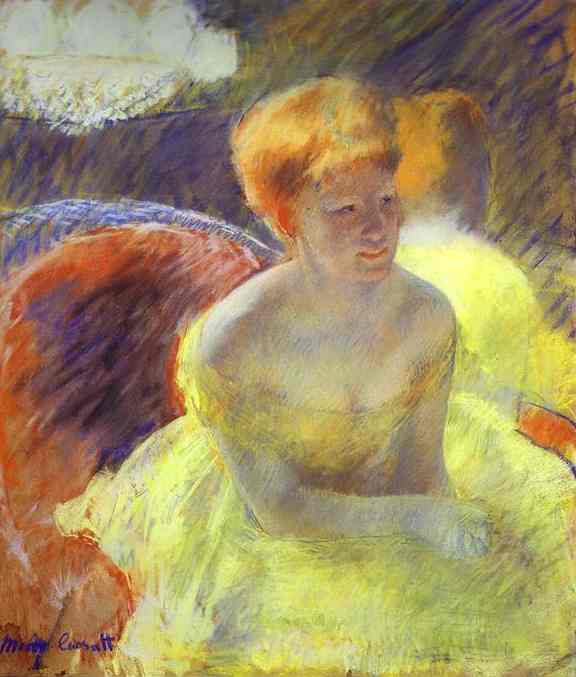
Mary Cassatt. At the Theater.. 1879-1880. Pastel on paper. The Nelson-Atkins Museum of Art, Kansas City, Missouri. Abcgallery.com

Givenchy L’Interdit Original : Perfume Review

44444

Audrey_white

Star rating: 5 stars–outstanding/potential classic, 4 stars–very good, 3 stars–adequate, 2 stars–disappointing, 1 star–poor.

Givenchy L’Interdit was created for Audrey Hepburn in 1957 by Francis Fabron on a commission from her friend and a famous couturier, Hubert de Givenchy and subsequently discontinued in the 1990s (in the US only, by all accounts, as it was still available in Europe). The House of Givenchy decided to reintroduce the fragrance in 2002 while reformulating it in order to make it more appealing to the younger generation. While Jean Guichard and Olivier Gillotin are talented perfumers, the outcome is a pleasant fruity-floral, well crafted, but not particularly memorable.

As for the original L’Interdit, it was a fragrance of elegant beauty, with a playful side. The opening notes are of aldehydes paired with bergamot, which soften considerably as the fragrance is allowed to meld into the skin and reveal soft peach and strawberry–ripe fruit warmed by the sun–on the floral backdrop of rose, jasmine and iris. The floral notes are not distinct, instead presenting a beautiful swirl of abstract shapes, with the edges blurring into each other. Yet, above this refined melody, spicy carnation adds some pleasant honeyed warmth, thus enhances the floral voices. Matte glow of amber paired with the earthy opacity of vetiver forms an elegant base upon which the floral notes recline, veiled by a powdery mist.

Photo: Paramount Pictures publicity still, 1956. audreyhepburn.com.

As Seen On

Design by cre8d
© Copyright 2005-2026 Bois de Jasmin. All rights reserved. Privacy Policy