Elegant: 198 posts

Versatile and polished blends

Balenciaga Le Dix : Fragrance Review

44444

Le_dix_2

Star rating: 5 stars–outstanding/potential classic, 4 stars–very good, 3 stars–adequate, 2 stars–disappointing, 1 star–poor.

The breeze entering the windows suddenly brings a scent of something bittersweet and sharp. A wave of melancholy overcomes me as I noticed the yellowing leaves and the chill that forebodes the change of seasons. I want to hold onto the time as it passes, and the best way to do so is to envelop oneself in a fragrance that speaks of another era.

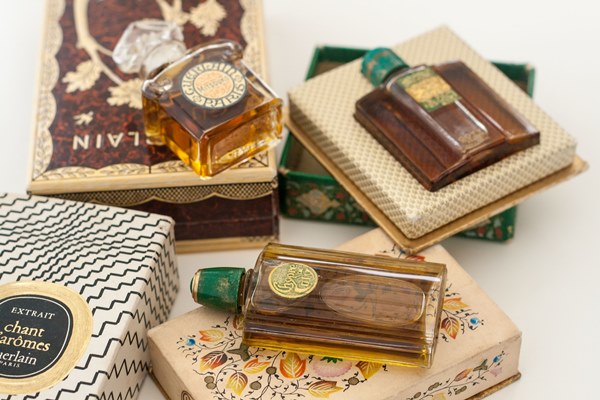
Created in 1947 by Francis Fabron, the perfumer responsible for such fragrances as the original 1957 version of Givenchy L’Interdit, Monsieur de Givenchy, and Nina Ricci L’Air du Temps, Balenciaga Le Dix is like a beautiful vintage dress that has lost none of its splendor, despite the passage of time. In fact, time only adds to its beauty.

Continue reading →

Divine L’Ame Sœur : Perfume Review

44444

Cassatt18

Star rating: 5 stars–outstanding/potential classic, 4 stars–very good, 3 stars–adequate, 2 stars–disappointing, 1 star–poor.

Divine L’âme Sœur creates an illusion of opalescent dust falling on dewy petals. The veil of aldehydes is, at first, hazy and opaque, however almost instantly it begins to fade revealing tropical opulence of ylang ylang and rich fruitiness of jasmine. While ylang ylang is a heady note, aldehydes render it ethereal and elegant, smoothing its rough edges and softening its sharp lushness. Indeed, Ernest Beaux was the first perfumer to discover the unique affinity between aliphatic aldehydes and ylang ylang, when he created Chanel No. 5.

L’âme Sœur, which means “Soulmate,” was created by Yann Vasnier for Divine, a fragrance house founded by Yvon Mouchel in Dinard on the northern coast of Brittany. If it is possible to conceive of a perfectly elegant fragrance that nods to the classical tradition without being repetitive, L’âme Sœur is it. A beautiful rose note lends an appealing sweetness to the heart of the composition, complementing the crisp white shimmer of aldehydes.

Once the fragrance dries down, a luminous note of ambergris resurfaces to support the composition. In L’âme Sœur, the peculiar winey and stunningly sensual scent of ambergris is present as a wave of warmth that softens the lush florals. Where rose was tempted to appear as heavy and sweet, it is rendered as sun drenched and delicate. The juxtaposition of sensual warmth with the cool aldehydic opening is what makes L’âme Sœur particularly exciting. The final result is not so much powdery as one would expect from an aldehydic fragrance, as it is reminiscent of cashmere. Cashmere softness that caresses the skin and holds its warmth is the association that the dry down of L’âme Sœur brings to mind.

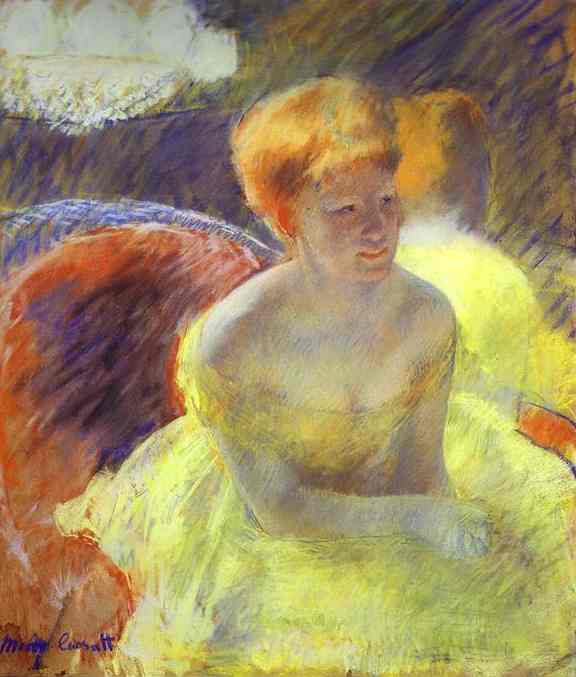
Mary Cassatt. At the Theater.. 1879-1880. Pastel on paper. The Nelson-Atkins Museum of Art, Kansas City, Missouri. Abcgallery.com

Divine L’Homme de Coeur : Perfume Review

44444

Monet_iris

Star rating: 5 stars–outstanding/potential classic, 4 stars–very good, 3 stars–adequate, 2 stars–disappointing, 1 star–poor.

The scent of iris is one of the most complex and elusive, weaving in metallic violets and snow covered roots. It is a melancholy fragrance by its nature, and it is fascinating to explore the possibilities it offers.

Divine is a small French perfume house located in Dinard on the northern coast of Brittany. Founded by Yvon Mouchel, its line includes three feminine and three masculine fragrances, out of which L’Homme de Coeur and L’Homme Sage are composed by a young perfumer Yann Vasnier. L’Homme de Coeur is an interesting interpretation of iris that exploits its crisp coolness more than its powderiness redolent of violets.

The iris leitmotif that is about to persist like a gentle melody throughout the entire composition is evident upon the first inhale. Tinged by sparkling juniper, iris steps in the background and allows cypress to dominate. The sheer scent of cypress, reminiscent of fresh pinecones and dry needles is a wonderful counterpoint to the metallic glow of iris. The spicy fruit scent of angelica lends an unexpectedly vibrant note that provides a perfect segue into the voluptuous iris heart. As the fragrance dries down, it warms up with sweet winey mustiness of ambergris. Yet, iris that provided a cool breeze leaves its mark, especially when its earthy and icy qualities are heightened by vetiver. As a woman, I feel perfectly comfortable wearing L’Homme de Coeur, however on a man, it is just ravishing.

Photo: Claude Monet. Monet’s Garden, the Irises. 1900. Oil on canvas. Musée d’Orsay, Paris. abcgallery.com

Frederic Malle Le Parfum de Therese : Perfume Review

55555

Fugit_amor

Star rating: 5 stars–outstanding/potential classic, 4 stars–very good, 3 stars–adequate, 2 stars–disappointing, 1 star–poor.

Frédéric Malle Le Parfum de Thérèse was created by Edmond Roudnitska, one of the most influential perfumers, the nose behind Rochas Femme, Diorella, Diorissimo and Dior Eau Sauvage among others. According to Frédéric Malle’s site, Le Parfum de Thérèse was composed in 1960s by Mr. Roudnitska for his wife, Thérèse. Upon the death of the master perfumer in the 1996, his wife allowed for the fragrance to be released to the public through Frédéric Malle.

Le Parfum de Thérèse is one of my favorites from the collection. The burst of sunny mandarin is followed by tart sweetness that reminds me of cantaloupe. A dry note of pepper softens the sweet fruity accord before green, yet animalic jasmine reveals itself. It is faint at first, however it becomes deeper over time. Roudnitska’s treatment of indoles–perfume materials that smell of decay and moth balls–in jasmine is fascinating. By amplifying the dark notes, he creates a genuinely sensual fragrance that straddles the fine line between seduction and repulsion.

While jasmine intensifies, violet and rose swirl out of the spicy green plum accords in the middle notes. The entire composition rests on a dry leathery base touched by earthy notes of vetiver. A fragrance both seductive and elegant, it unfolds gently on the skin, never failing to surprise me. I find something new in it every time I wear it.

Photo: Auguste Rodin, Fugit Amor (before 1887), marble, Musée Rodin, Paris. Photo by E. & P. Hesmerg.

Frederic Malle Iris Poudre : Perfume Review

44444

17_photo_by_keith_hamshere

Star rating: 5 stars–outstanding/potential classic, 4 stars–very good, 3 stars–adequate, 2 stars–disappointing, 1 star–poor.

My first thought when I tried Frederic Malle Iris Poudre was of Anna Karenina and Tolstoy’s description of a lovely black gown she wore for that fateful ball. Rich sumptious velvet, black with a slight purple iridescence is how I envision this fragrance from Frédéric Malle collection. The top notes of soft aldehydes are richly ornamented by ylang ylang, magnolia and jasmine in a classical manner that recalls Chanel No. 5. The sonorous chord of iris slowly unfolds against this shimmery aldehydic backdrop. Iris becomes more pronounced in the heart, where it is sweet and lush, without a metallic overlay that often accompanies iris notes. The warm base of vanilla and sandalwood envelops the silkiness of iris petals dusted with delicate aldehydic powder, lending a gentle and elegant feel to the drydown.

The fragrance was created in 2000 by Pierre Bourdon, whose some other fragrances include Yves Saint Laurent Kouros (1981), Davidoff Cool Water (1988), Shiseido Féminité Du Bois (1992, with Christopher Sheldrake), and Christian Dior Dolce Vita (1995, with Maurice Roger).

Photo: Sophie Marceau as Anna Karenina in Bernard Rose’s film. Still by Keith Hamshere from http://movies.warnerbros.com/anna/. I cannot say that this is my favourite film version of my beloved novel, but Sophie Marceau is stunningly beautiful in it.

As Seen On

Design by cre8d
© Copyright 2005-2026 Bois de Jasmin. All rights reserved. Privacy Policy