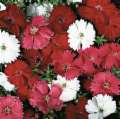
Carnation: 20 posts

Lorenzo Villoresi Garofano : Fragrance Review

33333

Carnation

Star rating: 5 stars–outstanding/potential classic, 4 stars–very good, 3 stars–adequate, 2 stars–disappointing, 1 star–poor.

A Florentine perfumer, Lorenzo Villoresi, officially opened his house in 1990, with the line currently including 15 fragrances. Created in 1995, Garofano contains lavender, green notes, floral notes, carnation, jasmine, rose, vanilla, heliotrope and musk. However, my initial impression of Garofano was of bright orange slices of melon dripping with honeyed juices. Soon the melon vision fades and the red rose blossoms out of the heart followed by jasmine and carnation. The rose is rather strong at first however it softens considerably and soon peppery carnation paired with exotic lushness of jasmine starts to sparkle. It remains clear and true carnation without powderiness until it is joined in the base by vanillic and buttery sweetness. Carnation becomes thickly overlaid by decadent musky notes. Heavy richness of the base clouds the wonderful sting of carnation, which is what I loved about this fragrance the most. If this fragrance had color and voice, it would be bright orange-red, and it would sing “La Donna Mobile” aria from Rigoletto.

Comme des Garcons Carnation : Fragrance Review

33333

Carnation_cdg

Star rating: 5 stars–outstanding/potential classic, 4 stars–very good, 3 stars–adequate, 2 stars–disappointing, 1 star–poor.

The fragrance attempts to capture the spicy bite of carnation and its sweetness by combining red pepper, cloves and rose, a fairly traditional ensemble. Unlike most carnation fragrances, Comme des Garçons Carnation lacks the characteristic powderiness, instead being heavy on a honeyed spicy chord, which takes the carnation warmth a notch too high. In fact, it is not too far from sweeping into the rose sweetness, without characteristic bite the carnation offers. Thus, if someone is looking for a true dianthus peppery warmth, Carnation is too sweet and too heavy on rose to be a decent representation.

Unlike many other floral notes, carnation lends strength and warmth to oriental and floral compositions without either compromising the delicacy of floral accords or rendering them too sentimental. Given the high cost of carnation absolute, I know of very few fragrances (JAR Golconda being among them) that employ the natural essence. Far more common are the carnation aromachemicals like eugenol, isoeugenol and eugenyl, among which eugenol and isoeugenol are considered to be allergenic.

JAR Parfums Golconda : Perfume Review

44444

Two_wild_roses

Star rating: 5 stars–outstanding/potential classic, 4 stars–very good, 3 stars–adequate, 2 stars–disappointing, 1 star–poor.

As far as niche fragrance house go, JAR is shrouded in mystery. Perfume notes and even names of specific perfumes are not revealed. Perfumes are currently sold only at the tiny boutique in Paris at the price level well above the average perfume buyer. Even the visit to the boutique is not unlike most perfume shops. Stepping inside the elegant boutique ornamented with teardrop crystal bottle sets the stage for enacting a period piece. Or an olfactory tea ceremony–admire the folded chamois cloth, small the fragrance, think and repeat. When you are ready to try the fragrances on your skin, a handsome Hungarian gentleman applies them slowly on your wrists, massaging them with a glass stopper. Oh, do not get me wrong, the visit to the tiny dusty rose hued boutique is definitely worth it. And not only for the wrist massage!

JAR was established in 1977 by Joel Arthur Rosenthal (JAR), with his Swiss business partner, Pierre Jeannet. A talented New York-born, Paris-based jeweler is particularly known for his extraordinary pave creations, which break all established conventions. The fragrances themselves do not have a classical top, middle, base structure, with the accords melding, undulating and swelling in an unpredictable fashion.

Golconda was among the first fragrances created by Rosenthal himself, employing the costly and rare carnation absolute. Although, at first, it is a true sun drenched carnation, the semblance to any carnation soliflore vanishes quickly. In fact, it becomes more like a true fire engine red lily, impossibly hot from the August sun. A hint of cinnamon and nutmeg enliven the exhilaratingly potent floral structure. The composition is very sultry and rich, glittering like a handful of rubies, without losing either its luster or its tenacity, the latter deserving particular praise. A mere drop suffices to last for the entire day and into the next! It shimmers like a precious jewel, set against a rich velvet backdrop.

The tear drop bottle is made of Baccarat glass can be obtained at 14, Rue de Castiglione boutique in Paris. However, soon New York denizens would be able to visit the JAR boutique at Bergdorf Goodman.

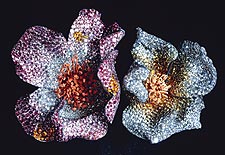
Photo: ‘Wild roses’ brooches by JAR. Diamonds, yellow, pink and violet sapphires, yellow and pink tourmalines, citrines and orange garnets, silver and gold and enamel.

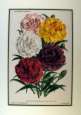
Carnation (Dianthus caryophyllus) : Perfume Note

Dianthus is derived from Greek, meaning di, Zeus and anthos, flower, “the flower of Zeus,” indicating its importance in the religious context of Ancient Greece. In Italy, Bologna in particular, the plant has been associated with Saint Peter and celebrated widely, with a special day at the end of June dedicated to carnation. In the Middle Ages, it was one of the most popular flowers for fragrance gardens. No monastery herb garden would be complete without carnation, the medicinal uses of which were referenced as early as the Han Dynasty texts (23-206 A.D.). In European herbal medicine tradition, carnation flowers have been prescribed for the nervous and coronary disorders. However, its probably most interesting usage has been recorded in the late 1600s, when the Countess of Dorset, England, made her own love potion, including carnation, lavender, bay leaf and marjoram. It is rather ironic that the flower of the most licentious of all Greek gods is supposed to have powers to cure wayward lovers. Interesting to note is that carnation signified devotion and loyalty in a variety of traditions, from European to Asian.

I have always associated carnation with the Soviet holidays, especially November 7th and May 1st, celebrating Russian Revolution, the successful Bolshevik coup d’ état against the Provisional Government (also called October Revolution, as Russia used the Julian Calendar, in which November 7th corresponded to October 25th) and the Soviet workers, respectively. Neither would be complete without some dreaded parade, after which we, young pioneers, would have to give red carnations to the various party functionaries present. Moreover, Krasnaya Moskva (Red Moscow), a rich carnation-based fragrance, was used liberally and widely, due to the fact that hardly much else was available. Therefore, for the longest time, carnation was associated with my Russian language and literature teacher, who would call me “a vestige of aristocracy,” because I exhibited an anti-working class spirit by refusing to attend the young pioneer choir practice and to collect paper and iron objects for our school (to heaven knows what purpose). I suppose that now these memories are heavily tinged with nostalgia for me, because I hardly mind the scent of carnation anymore, which is also a scent of my great grandmother’s garden, where I spent many summers of my childhood.

The flower, native to the Mediterranean region and India, has been at the height of its popularity in France of Louis XIV reign, when it was selected as a flower of the court. In the 19th century, carnation (dianthus) lovers formed clubs, and although carnation fever never reached the level of tulip obsession, the flower had many devotees. In fragrances, the same tradition can be observed, with the classical compositions featuring carnation in a variety of ways, particularly to add a peppery warth to the floral compositions. However, the modern treatment of carnation has been to deem it old-fashioned and trite. Yet, the solitary flowers, with the corolla of dark red fringed petals have an intense spicy smell that lends itself wonderfully to oriental blends. Combined with rose, it lends a spicy note that adds complexity to the sweet rich glow of rose.

Essential oil is present in the small amount in petals of the carnation variety, which is called “clove pinks,” hinting at the similarity between the smell of carnation and clove. In Russian, carnation and clove, although unrelated species, are bound by etymological ties. “Gvozdika”, with the root “gvozd’” referencing the nail-like shape of the spice clove, is the common name for both the flower and the spice. Both are rich in eugenol, which gives carnations and cloves their characteristic sweet heavy scent.

Produced mostly in France and Holland, carnation absolute is rare, with a heavy, spicy floral aroma tinged by sweet dark honey notes. It is a blend of clove, black pepper and exotic sweetness of ylang ylang, which incidentally are often used to reproduce carnation scents. Absolute is a greenish jelly like substance. 500kg of flowers are required to produce 100g of oil. In perfumery, it is common to employ synthetic substances like eugenol, isoeugenol and eugenyl acetate to accentuate floral character and to lend clove and carnation like scent.

Carnation solifores: Caron Bellodgia, Floris Malmaison, Lorenzo Villoresi Garofano, Comme des Garcons Carnation, JAR Parfums Golconda, L’Artisan Parfumeur Oeillet Sauvage.

Classical perfumes containing carnation: Caron Poivre and its EDT version Coup de Fouet, Caron En Avion, Caron Or et Noir, Caron Tabac Blond, Caron Fleurs de Rocaille (1933), Guerlain Après l’Ondée, Guerlain L’Heure Bleue, Je Reviens by Worth, Givenchy L’Interdit (original), Nina Ricci L’Air Du Temps, Schiaparelli Schocking, Estée Lauder Youth Dew, Robert Piguet Bandit, Dior Dioressence.

Modern perfumes containing carnation: Yves Saint Laurent Opium, Guerlain Vétiver, Maître Parfumeur et Gantier Soie Rouge, Carthusia Fiori di Capri, Mon Classique by Pascal Morabito, Lauren by Ralph Lauren, Red Door by Elizabeth Arden, Gucci No. 1, Boucheron Jaïpur Homme, Cartier Must II, Yves Saint Laurent Jazz, Molyneux Quartz, Hermès Bel Ami, Fendi Theorema, Estée Lauder Cinnabar, Estée Lauder White Linen, Estée Lauder Estée, Estée Lauder Spellbound, Guerlain Samsara, Balenciaga Cristobal, Gaultier Fragile, Dior Jules, Dior Fahrenheit, Gucci Envy for Men, Lanvin Lanvin for Men, Bvlgari Bvlgari for Men.

Bibliography: Bown, D. 1996. Encyclopaedia of Herbs and their Uses. Dorling Kindersley, London; Morris, Edwin T. 1984. Fragrance: The Story of Perfume from Cleopatra to Chanel. E.T. Morris and Co., New York, 233.

Guerlain Apres l’Ondee : Perfume Review

55555

Guerlain Après l’Ondée was created by Jacques Guerlain in 1906.  I loved this scent right away for its wonderfully delicate combination of orange blossom and violet, tinged with a spicy anise note.

Md

The first accord is reminiscent of a spring garden after a tempestuous May shower as the damp earth, drenched leaves and flowers begin to warm up under the sun. The aura of this fragrance is effervescent, innocent and joyous. But there is a dark timbre to Après l’Ondée as well. It is similar to the moment after the rain is over; the sun is shining, yet the clouds still cast somber shadows upon the landscape. The heart blossoms with iris and violet, which much to my delight, is a departure from the traditionally sweet candy-like violet notes. The carnation is subdued and merely adds a spicy ornament. The dry down is smooth and tender, with the sugared almond, vanilla and musk lending it an abstract gourmand sensation. Après l’Ondée is a garden in the first flush of bloom, yet to reveal all of its secrets.

Continue reading →

As Seen On

Design by cre8d
© Copyright 2005-2026 Bois de Jasmin. All rights reserved. Privacy Policy