Tuberose: 48 posts

Caron Tubereuse : Fragrance Review

33333

Anna pavlova costume giselle

Star rating: 5 stars–outstanding/potential classic, 4 stars–very good, 3 stars–adequate, 2 stars–disappointing, 1 star–poor.

Caron Tubereuse is a fragrance I often think in terms of dance. Reading perfume reviews I am always struck by a variety of references to capture scent. Music language of chord, tremolo, crescendo and modulation; gustatory of bitter, sweet, sour; visual of matte, transparent, iridescent… The list is endless, and is contingent upon a reviewer’s way of identifying sensations and connecting with the world. At the same time, it also underscores the inadequacy of our language to capture scent.

Continue reading →

Parfums de Rosine Mea Culpa : Fragrance Review

22222

Update: Mea Culpa has been discontinued.

Star rating: 5 stars–outstanding/potential classic, 4 stars–very good, 3 stars–adequate, 2 stars–disappointing, 1 star–poor.

Marie-Hélène Rogeon reintroduced Les Parfums de Rosine in 1991. The house created several unusual rose fragrances. Mea Culpa which debuted in the 1990s is a departure from this tradition as it is classified as a tuberose scent, and after Rogeon decided to revert to rose scents exclusively, this fragrance was discontinued. Mea Culpa opens up with creamy white roses and a hint of tuberose before losing some of the sweetness and gaining an aquatic quality. Tuberose is never pronounced, although it does become more apparent in the middle. It hides in the background and adds a lush quality to other notes. Jasmine appears soon thereafter adding its rich fruity note. Contrary to expectations, this fragrance is not what I would consider a heady floral, it is understated with floral notes intertwining beautifully. The final result reminds me of aquatic flowers–water lilies resting on the dark surface of a pond, pink lotus raised above the dark surface–due to the cool and fresh notes of the dry down which completely surprised me. Although Mea Culpa deserves a merit of the lightest tuberose fragrance I have tried, after a while it starts to lose its multifaceted quality, softening into a pleasant, but flat floral.

Continue reading →

Tuberose : Perfume Ingredients and Notes

Tuberose
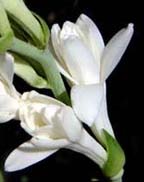
Nothing captures better the essence of tuberose than its meaning in the language of flowers, used in Victorian England. Tuberose signified both dangerous pleasure and voluptuousness. The scent of the flower is a fusion of white petals and warm skin, an arresting sensual and heady fragrance. On a blotter, tuberose absolute opens up with a faint green note before warming into a sweet jasmine-like scent underscored by a rubbery accord. It vacillates between the coconut sweetness and the warm skin impression, as it dries down.

Tuberose (Polianthes tuberose) is plant belonging to the lily family (Amaryllidaceae) native to Central America. Like most night blooming flowers, tuberose is pollinated by nocturnal moths, which explains the white shade of the flowers. Like jasmine, tuberose continues to produce its scent even after the flower is picked, thus, lending itself as a perfect candidate to the traditional painstaking enfleurage method. Steam distillation with its high temperature is not a feasible way to extract the absolute. While enfleurage is a traditional method traced back to Ancient Egypt, solvent extraction using hexane is far more common. Either method is time consuming, requiring 3600 pounds of blossoms to produce 1 pound of the absolute, which is why tuberose oil is among the most expensive in perfumery, more than $2,000 per pound (as of 2005.)

Continue reading →

As Seen On

Design by cre8d
© Copyright 2005-2026 Bois de Jasmin. All rights reserved. Privacy Policy