Perfume Notes: 112 posts

Articles on perfume ingredients and fragrance terminology

Carnations, Cloves, Eugenol : A Short History

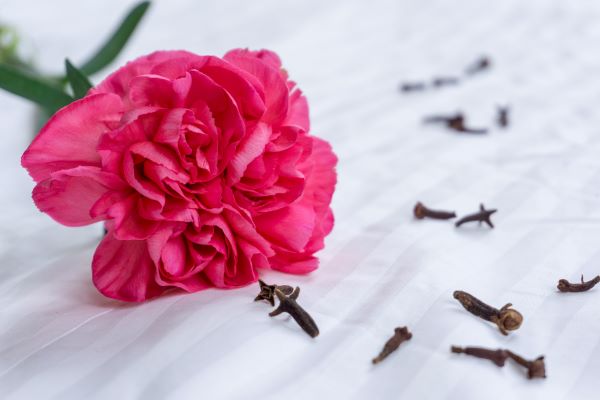
Carnation is not the trendiest of floral notes, and yet modern perfumery would be unthinkable without it–or specifically, the carnation effect. One of the principal aroma-molecules in the essence of carnation is eugenol, and its discovery was revolutionary. In 1834, eugenol was synthesized by Carl Jacob Ettling. In 1858, it was studied and named by August André Thomas Cahours, another brilliant chemist, whose contributions to organic chemistry are numerous. If you wish to know what eugenol smells like, sniff a pot of cloves. There is a reason why Ettling turned to this spice to obtain eugenol–clove essence contains up to 90% eugenol, depending on the variety.
Eugenol was and remains important not only in perfumery, but also in pharmaceuticals, cosmetics, the food industry, and above all, dentistry. It’s known as an effective pain reliever, and to this day, it’s mixed into zinc-oxide-rosin cements for certain types of fillings. For this reason, those who have had the misfortune of experiencing root canal work associate the scent of cloves and carnations with the dentist’s office.
Continue reading →

6 Luminous Musk Perfumes

Why should summer be all about colognes and fresh florals? Why not don a plush tuberose or a bittersweet chypre? Why not explore how our dark and glamorous favorites behave when the weather grows warmer and days longer? None of the “perfume wearing rules” annoy me more than the set-in-stone seasonal suggestions. I suspect that most of them are designed to make people buy more product, rather than enjoy what they already have. The only rule in perfume is to wear what smells good to you (in quantities appropriate for the occasion, of course). A new season is a new chance to experiment, and there is nothing better than experimenting with your favorites and discovering new facets in them.


Musk perfumes, for instance, are among the most versatile. They can be modulated by the type of application. They linger. They range from heavy and warm to radiant and bright. With this in mind here is my list of summer musks–although I wear them all year round.

Continue reading →

The Beautiful Lactones : Of Peaches, Cream and White Flowers

What are lactones and why are they so enticing? As their name hints, lactones are organic compounds with a milky, creamy scent. Lactones lend their characteristic scent to peaches, milk, tuberose and even spicy vegetables like celery and lovage. They occur in white meat, which is one of the reasons why prosciutto and mozzarella or prosciutto and fruit make for such a delectable combination.

With their voluptuous qualities, lactones are well-suited to perfumery and they are among the most commonly used materials. The most famous example of the use of lactones is Guerlain Mitsouko. As I’ve explained in my previous article, in 1919 Jacques Guerlain experimented with gamma undecalactone, which had been discovered only a few years earlier. He found that when he wove this peach skin-redolent material into a dramatic mossy-woody accord popularized by Coty Chypre in 1917, the effect was that much more vivid and luscious. The rest, as they say, is history.

Continue reading →

Single Note Perfumes

Simple is rarely a compliment when applied to perfumes. Fragrances compared to symphonies or classic multi-volume novels are thought to be superior. Yet, as any perfumer knows, creating a simple composition is complicated. When the palette is reduced to a few key elements, the selection of each material becomes critical. It is even more difficult to create a fragrance that evokes a single impression, that of a flower, a root, or a leaf.

Composing a perfume that smells realistically of a flower, say, a rose, is part of the challenge, but it’s not the biggest one. The more elusive goal is how to suggest a story and give it character. The purpose of a perfume is not to replicate nature, but to weave a fantasy. All of us have our own idea about how a rose smells, and a successful rose perfume will not try to compete with a summer garden. Instead, it will evoke its own universe.

Continue reading →

Power to the Pumpkin in Art and Perfume

In my recent article in FT magazine, Power to the Pumpkin, I explore the Japanese artist Yayoi Kusama’s way with pumpkins–as well as that of perfumers. Both are fun and surprising.

“My love of pumpkins stretches back to when I was a little child. I have always found them to be such tender things to touch and so wonderfully humorous, humble and appealing,” says artist Yayoi Kusama about the most recognizable motif of her work. Her pumpkins are cast in bronze, covered in polka dots or lit by a warm glow. The effect is both whimsical and eerie, echoing associations with childhood pastimes and autumnal stillness. Continue reading →

As Seen On

Design by cre8d
© Copyright 2005-2026 Bois de Jasmin. All rights reserved. Privacy Policy