The last time I re-read The Gates of Europe was in Kharkiv. I was waiting for a friend at Makers, a coffee shop and artistic hangout in the city center. Kharkiv is the easternmost city in Ukraine that lies only 30 kilometers from the Russian border. This unfortunate geography makes it a target of near-daily bombardment. Just weeks earlier, Makers had replaced its large oval windows after a night of shelling, but when I sat there reading in its high-ceilinged, sunlit space, it felt like any other café in a busy urban center. Except that my phone kept buzzing with alerts about incoming drones and ballistic missiles.
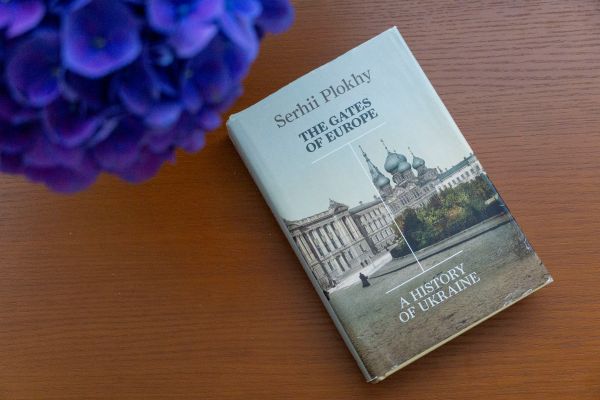
Serhii Plokhy, a Harvard historian, published The Gates of Europe in 2015, one year after the annexation of Crimea and the start of war in the Donbas. Although the book spans over two thousand years of history, the narrative felt startlingly immediate, like reading the blueprint of a city I was only beginning to understand. Ukraine, in Plokhy’s telling, is not a periphery of someone else’s empire. It is the center of its own story—layered, scorched, reborn. That I was reading the history of Ukraine in Kharkiv, a city that embodies these layers and this capacity for rebirth, felt deeply significant. Clearly, I have a taste for immersive reading experiences.
Plokhy opens with Herodotus and ends in the smoke and uncertainty of the Donbas. He moves briskly from Scythians to Sarmatians, from Byzantium to the Baptism of Rus’, through Mongol invasions, Cossack uprisings, Habsburg borderlands, Soviet famines, and finally to the post-2014 war. What could have been a dizzying chronology becomes, in his hands, a coherent argument: Ukraine has always existed at the gates—of Europe, of empire, of history’s shifting definitions—and it has always resisted easy categorization.
What I admire most is his restraint. Plokhy avoids sentimental nationalism. He doesn’t collapse Ukraine into its Russian or Polish pasts. Instead, he insists on complexity. He allows contradictions to stand: a hetman loyal to the Tsar but dreaming of autonomy; a language both native and politicized; a land fertilized by poetry and blood. The book is smooth to read, but it’s solid, serious history. This is why I return to it. Sometimes I re-read it in full. Other times I revisit specific chapters: on the Cossacks, on WWII, on Kharkiv.

And yet, during this latest reading, The Gates of Europe inspired me to think deeper about the less tangible archives. Since 2024, I’ve spent over six months in Ukraine, visiting more than twenty towns across nearly every region. Each place left its own unique imprint on me—its scents, its palette, its cadence of customs and gestures. I kept wondering: what did the weekly market in a Poltava town smell like three hundred years ago? What fragrance lingered in a village church during Palm Sunday rites? Did the steppe gleam sunflower gold the way it does now, or was it once splashed with other hues?

This is where I step in—not as a historian, but as a chronicler of the sensory, the invisible, the fragile. My Ukraine lives not only in footnotes but in the taste of sour cherries, the sound of a local wedding song, the faint scent of smoked pears drifting through warm August air.
I often return to a passage in Serhii Plokhy’s work on the Soviet famine—the Holodomor—where he lays out the staggering numbers: millions dead, entire regions emptied of life. But the magnitude of that suffering, historians warn, is ultimately incomprehensible without testimony. To begin to grasp it, one must read memoirs, fiction, poetry. Or travel, meet people, and listen. That’s all part of research and seeking deeper understanding.
I was raised by my great-grandmother, a Holodomor survivor. Her fragmented stories shaped my earliest understanding of history. Much of my writing, and especially my work in oral history, has been an attempt to trace the shape of that inherited trauma. It was passed down like a bitter inheritance: not always in words, but in silence, gestures, and the rituals of daily life. To write is, for me, a form of listening to the voices that were nearly lost, and to the quiet grief still carried in many Ukrainian homes.

Such textured, sensory history is impossible without the scaffolding of rigorous research. When I finished The Gates of Europe in Kharkiv, I was reminded why I so often recommend it. Plokhy invites you to look into layered histories, unspeakable traumas, and astonishing resilience. And he invites you to look outward—toward a Europe that has too long ignored this threshold, and now can no longer afford to.
I recommend this book to anyone seeking to understand Ukraine beyond war headlines. But read it slowly. Let it build. And after the final page, turn to a Ukrainian poet, an artist, a grandmother’s recipe. Let the history breathe in the present tense.
What books have helped you better understand a place—or changed how you see its history?
Serhii Plokhy, The Gates of Europe: A History of Ukraine, 2015.



























16 Comments
Noemí: Javier Marías’ Tomorrow In The Battle Think On Me, his stream of consciousness while he walks Madrid. A city where I lived for seven years as an outsider but becomes intimate in Marías’ prose. July 21, 2025 at 10:03am
Victoria: Yes! The way Marías drifts through Madrid, binding memory, grief, and longing into the very architecture of the city is incredible. It captures that dissonance of being both inside and outside a place. July 22, 2025 at 12:16pm
Filomena: Thank you for sharing this. July 21, 2025 at 11:21am
Elizabeth: Fantastic review Victoria but reading it, I was struck by how AMAZING it would be if you told the story of Ukraine through women’s stories and testimonies. You could take a woman from each important era or choose say, 7 women because women have traditionally been denied their voices in history yet we know they were there influencing, shaping, surviving whether high or low born. I would LOVE to read something like this from you! July 21, 2025 at 11:30am
Victoria: Thank you. You’ve put your finger on something I’ve been turning over for a long time. Ukrainian women have been the weavers of history’s silent fabric—resilient, ferocious, and so often overlooked. July 22, 2025 at 12:17pm
Victoria: Thank you for reading. I’m glad it resonated. July 22, 2025 at 12:16pm
Maria Brent: Such good writing—-yours and Plokhy’s. Thank you. I intend to read this book. July 21, 2025 at 11:39am
Victoria: Maria, thank you, that means so much. Plokhy’s work opened new windows for me, and it felt important to pair it with my own lived reflections. I’d love to hear what you think of the book when you read it. July 22, 2025 at 12:17pm
Awfulknitter: I’ve asked my local library to buy this in. I remember finding Plokhy’s ‘Chernobyl’ compelling. While I wait for that, I’m looking forwards to reading Olia Hercules ‘Strong Roots’, which is in the to-read pile. July 21, 2025 at 4:43pm
Victoria: That’s wonderful, thank you for requesting it. Chernobyl left a deep impression on me too. And Olia’s is a delight. I think the two books in dialogue will offer something powerful. July 22, 2025 at 12:18pm
Klaas: What a beautiful, thought provoking post, Victoria. The book sounds like a must read! July 22, 2025 at 2:43am
Victoria: Thank you, Klaas. That means a lot. It’s a book I return to again and again and each time, it unsettles and anchors me in equal measure. July 22, 2025 at 12:18pm
Alityke: Thank you Victoria. I shall order this from my local library July 22, 2025 at 12:12pm
Victoria: Thank you! I’m always delighted when libraries carry such books. July 22, 2025 at 12:19pm
Alityke: My town has had a large Eastern European community since WW2. Hence the library has this & other books focusing on that part of the world. July 22, 2025 at 1:26pm
rickyrebarco: I ordered this book and it has arrived. I’m looking forward to reading it. July 31, 2025 at 3:02pm