Ballet Inspired Perfumes

In my FT magazine article Ballet in a Bottle?, I describe several perfumes inspired by ballet or created in collaboration with ballet dancers. The results are fascinating–the spirit of ballet has a lot in common with perfumery, from its ineffability to its complexity.


“Writing about music is like dancing about architecture.” This wonderful quote nonetheless misses the mark. Music can be captured in words just as dance can be used to understand shapes and forms. What’s more, perfumers working in collaboration with ballet artists have shown that one can even smell adagios and allegros.

Such was the idea behind Iris Prima, a fragrance by Penhaligon’s. Working with the English National Ballet, master perfumer Alberto Morillas chose iris to evoke the vision of a dancer on stage. An ingredient derived from the roots of iris pallida, at first it suggests the scent of violet petals.  Yet, the delicate opening gives way to frozen woods and intensely green buds. The same juxtaposition of ethereal lightness and strength is the hallmark of a ballet, and Iris Prima captures it perfectly. Its floral softness is challenged by woods and musk, and while the contrast is strong, the result is harmonious.

Continue reading →

How a French Perfume Company Influenced Ukrainian Embroideries

One of the most quintessentially Ukrainian embroideries is called rushnyk (pl, rushnyky), richly decorated hand towels that accompany a person from birth to death. In two videos that I recorded, I would like to show you rushnyky embroidered by my great-great grandmother. I discovered them by accident when I was cleaning out our shed and spotted a large chest hidden under old rugs. The drawers were jammed, but I persevered and opened them only to discover decaying paper and mouse droppings. I rummaged in it–no, I’m not even one bit squeamish–and I found the embroideries. I cleaned and restored them and it’s a pleasure to share them with you.

My great-great grandmother Pasha wove the cloth on a hand-loom, and she then decorated it. These embroideries are at least 70 years old, and yet they are remarkably resilient.

Continue reading →

How to Learn Multiple Languages at the Same Time

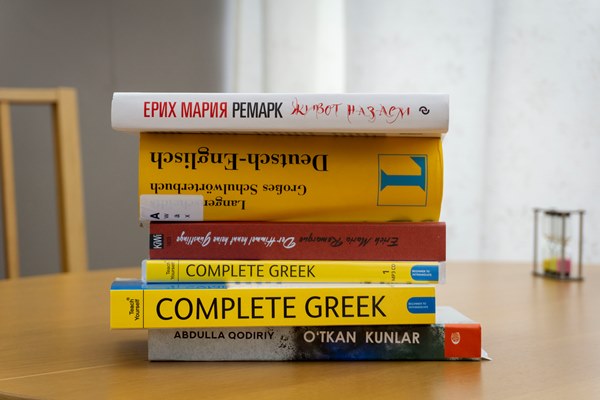
It’s usually recommended to focus on one language at a time, become fluent in it and only then start learning another one. However, language acquisition is a continuum, and some of us need to study languages for work or travel. Others are impatient. And yet others are passionate about languages and the process of learning by itself excites them. In short, it’s possible and sometimes beneficial to learn more than one language at a time, and I will share how I do it. Please take a look at the other articles in my language learning series, and share your experiences with me.

A few caveats, however. First, if you’re studying your first foreign language, then taking up two at the same time will not work. It will be too overwhelming. Second, if the languages you’re learning are too similar, you might consider learning one until you reach an intermediate level and only then start the other one. Third, if you can’t devote the time, it’s best to limit your ambitions. If you need at least 10 hours of practice a week to progress, then you’d require twice as much to learn two languages.

Imagine that you would like to focus on learning Spanish and Russian. Your Spanish is at a lower intermediate level, while you’re a total beginner in Russian.

Continue reading →

Exercises to Sharpen Sense of Smell : Cloves and Roses

Starting one’s morning by smelling consciously is the best and the easiest way to sharpen your sense of smell. I’m sure that many of you who are reading this blog on a regular basis are already using your nose to its full potential, but if you would like to improve your olfactory vocabulary, distinguish scents better and learn to smell with more focus, I would like to share short videos with professional tips. The sense of smell becomes less acute with age, but by introducing such exercises into our routine, we’re ensuring that our noses remain as sensitive as can be possible given our genetic makeup and lifestyle. I’ve already posted a video on the basic principles of smelling in Bois de Jasmin’s YouTube channel, and the next installments will cover different techniques in more detail–smelling in images, looking for nuances in scents, etc.

This is a typical exercise I use in the morning. I pick anything scented–it can be a box of spices, a packet of coffee or a blotter dipped into an essential oil and think of images it evokes. It’s easier to do this exercise blindly (place spices in unmarked jars and smell with your eyes closed), but even if you know what you’re smelling, try to think only of the smell. What does it evoke? What does it smell of (other than the object you’re smelling)? It helps to write down your impressions, and if you like, you can share them in the comments here.

Continue reading →

The Turkish Art of Kolonya or How to Wear Cologne

The sight of a driver bearing a bottle of kolonya on the bus journeys across Turkey has always left me with mixed emotions. They always insisted on waking you up and then drenching you with perfume, whether you wanted it or not. On the other hand, a splash of kolonya always felt refreshing, and I became so used to the ritual that I began to practice it myself whenever I needed a pick me up. Using my Turkish friends’ example, I would pour kolonya generously into my hands, rub and whatever remained, I’d dab over my clothes. Of course, one needs a light, cologne-style perfume to accomplish it successfully, and Turkish kolonya is perfect.

Kolonya comes from the word cologne, and it became popular in the court of sultan Abdülhamit II (1876 – 1909) before taking over the rest of the country. Kolonya supplanted rosewater, which was used in a similar manner, since it was seen as antiseptic and cleansing. Kolonya is still offered to people at the restaurants and cafes. Kolonya is the first thing you’d offered entering a Turkish home, along with a plate of candy. The former is for cleanliness and refreshment, while the latter is for ensuring a sweet conversation, according to one Turkish belief. The kolonya culture is part of an old tradition of hospitality and sharing as well as a reminder that perfume was once valued for its salutary properties.

Continue reading →

As Seen On

Design by cre8d
© Copyright 2005-2026 Bois de Jasmin. All rights reserved. Privacy Policy