Perfume 101: 517 posts

Here you can find how to guides to selecting, testing and enjoying scents. Also includes are the lists of our top favorite perfumes for different occasions and articles covering all range of topics related to fragrance. If you’re curious to step inside a perfume lab (or even become an industry professional), this group of essays will be of interest.

Opulent Fragrances To Escape Routine and Grey Weather

With everyone enraptured by minimalism, Cleanfluencers, and Marie Kondo, it seems in bad taste to suggest the need for opulence, especially since what I have in mind is Bollywood’s “more is more” variety. There are two reasons for my insistence—excitement is a good thing, and I love Indian cinema.

Many people outside the Bollywood sphere of influence find the genre puzzling. Everything is over the top—the acting, the plots, the songs, the outfits. But for me, it’s “cinema that exists slightly outside the everyday world,” in the words of writer Rana Dasgupta. This fantasy space is shared by perfumes, intangible messages in a bottle. So, those wishing to take a break from KonMaring their sock drawers and making their apartment look like an IKEA showroom are welcome to follow along with me.
Continue reading →

Top Classical Patchouli Perfumes : Part 1 Patchouli

A green plant that evokes the scent of earth. A leaf that smells like wood. A wood that smells like chocolate. Patchouli is a complex, intriguing, and polarizing ingredient in a perfumer’s palette. Some like it, others hate it. It leaves nobody indifferent. Yet, it’s also a material that gives perfumery today its distinctive character. A modern chypre can be made without oakmoss, but not without patchouli.

My latest video is part of a patchouli series, and in the first episode I discuss the material itself and cover classical patchouli fragrances. The way patchouli is processed affects its smell dramatically. A steam-distilled patchouli oil smells earthy, musty, loamy, while solvent-distilled patchouli absolute is reminiscent of cacao and dry woods. Other methods allow distillers to recompose fractions of patchouli essence to highlight certain effects, such as its licorice or sweet notes.

Continue reading →

What Makes A Perfume Great

“The art of fortunate proportions” is how Edmond Roudnitska described perfumery. According to the legendary perfumer, a good fragrance has balance and an original form, a simple idea that is far from easy to realize. Roudnitska spent his career creating fragrances that exemplify perfumery at its most artistic—Christian Dior Diorissimo, Eau Sauvage, Diorella, and Rochas Femme. His compositions have elegance and character, but one of the distinctive trademarks of Roudnitska’s style is balance.


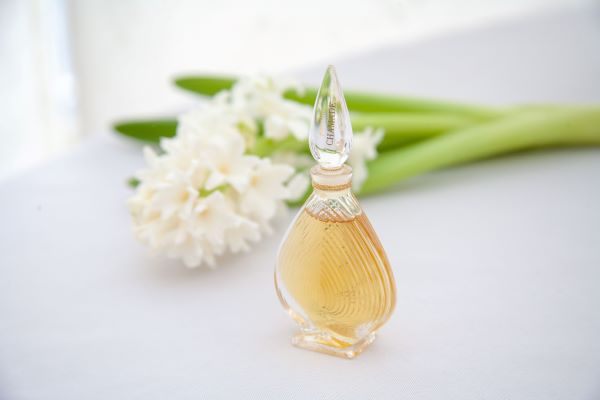
When I speak of balance in perfumery, I mean both the aesthetics and the technique. Consider Guerlain’s Chamade, one of the most perfectly balanced fragrances. From the bright green top notes to the rose and hyacinth heart and the velvety woody notes, the perfume unfolds like a silk scroll.  Similarly modulated is Dior’s Diorissimo, where the musky and spicy notes balance out the floral and green accords.

Continue reading →

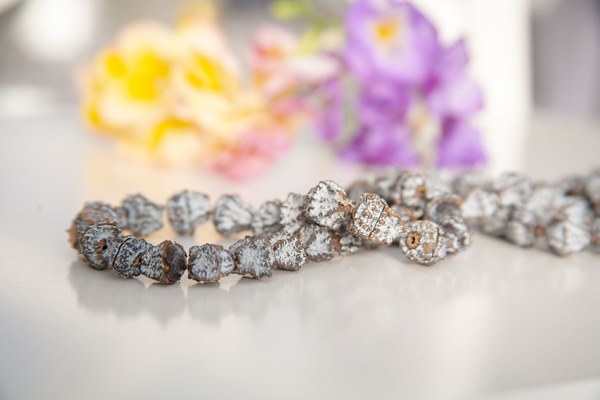
Corsican Eucalyptus and the Scent of the Maquis

A few years ago I met a woman who talked about her fiendishly complex emigration from Russia to Israel in the ’80s and how instead of Jerusalem she ended up living for a year in Ajaccio, the capital of Corsica. I asked what Corsica was like, my own mental image comprised mostly of Napoleon, the French Foreign Legion, and Laetitia Casta. She reflected for a moment and then said that it smelled heavenly. She meant the smell of the maquis. Since then I’ve been obsessed with the maquis, or as it’s known in Corsican, machja.

In Corsica, the maquis is ever-present–this wild scrubland vegetation covers nearly 20% of the island. Even when you don’t see it, it fleets before you in bits of folklore and stories. For instance, the guerilla fighters of the French Resistance in World War II were called maquisards, from the maquis (pronounced in French as ​[maˈki]) that reach up to 10 feet and make for an ideal hiding place. The maquis provides food, medicine, and lore. The scrubland starts at the sea coast–le maquis bas, climbs higher–le maquis moyen, and clings to the mountains–le maquis haut. These low, middle, and high maquis are woven of more than 2,500 varieties of wild plants, and their aromas build up slowly like a pyramid of a perfectly constructed perfume.

Continue reading →

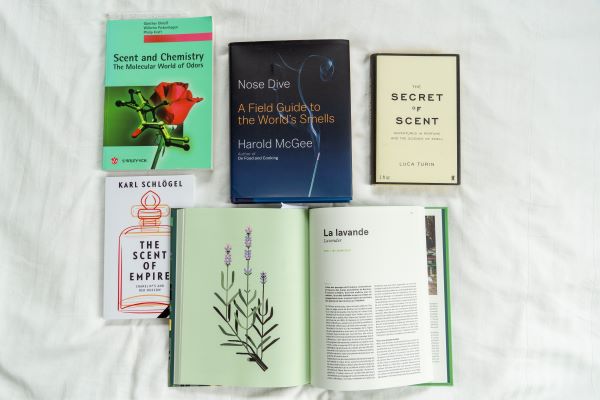
Favorite Perfume Books to learn about history, science, and techniques

Whenever I’m asked about my favorite books, two parallel thoughts flash through my mind–how much time do you have to listen to me and which are my favorite books. As someone who reads in all genres and on all topics, I have difficulty pairing down my favorites to to a small-talk appropriate list. However, when it comes to perfume books, I have no difficulty answering the question; my most read books are always within reach. Today, I will start with a list of books that I use for reference. I read them cover to cover and dip into chapters at random to learn about perfumery techniques, styles, or the fragrance industry.

Nose Dive: A Field Guide to the World’s Smells by Harold McGee

I first talked to Harold McGee about this book project more than ten years ago, but I believe that it took him even longer to research it. The wait has been worth it. McGee’s erudition sparkles on every page, and you can open the book on any chapter and find something new about aromas, molecules, emotions — and your own nose. It’s a study of olfaction as well as the world as we experience it through our senses. McGee weaves his personal experiences throughout his discussions, which gives Nose Dive its rich, layered quality. If you’re familiar with McGee’s writings on food and the science of cooking, you don’t need me to advertise this book further. Highly recommended.

Continue reading →

As Seen On

Design by cre8d
© Copyright 2005-2026 Bois de Jasmin. All rights reserved. Privacy Policy