ukraine: 84 posts

Scented Saints, Written Images, Endangered Heritage

Beautiful sillage is a sign of sainthood in the Orthodox tradition. The fragrance, or mirro (holy myrrh), can be emitted by real life saints, saint’s relics or even icons, painted images of saints. It’s common even today to hear stories of icons shedding myrrh and filling the whole church with the heavenly scent. Such events are called thaumata, a Greek word for wonders. They’re not miracles in the supernatural sense like walking on water or feeding 4,000 with seven loaves of bread. Thaumata are everyday marvels, brief glimpses of the divine through the veil covering us. The same kind of wonder is held responsible for icons, because to paint a saint it’s not enough simply to have artistic skills. One has to be inspired.
lavra-artist-studio1

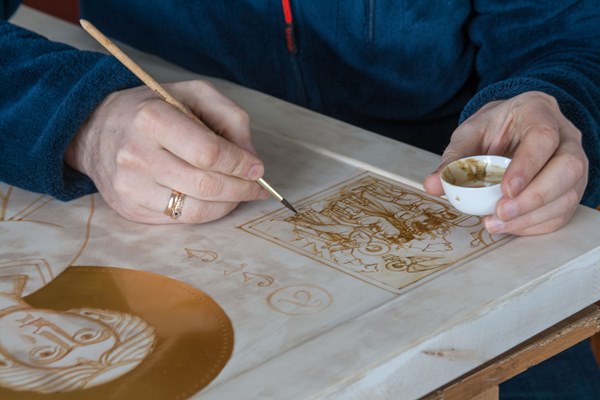
“I didn’t mean to become an icon painter. It was never my goal as an art student. I can’t explain it, but in the end, that’s just what happened,” says Natalya Gladovska, an icon painter at the Lavra Art Studios. My mental image of an icon painter owes much to Tarkovsky’s Andrei Rublev–a somber bearded monk in black robes. Gladovska laughs when I tell her so. She’s warm and bubbly, and everything about her, down to her tendrils of abundant red hair escaping from a loose bun, is filled with energy and verve.
Continue reading →

Petrykivka : Ukraine’s Vibrant Treasure

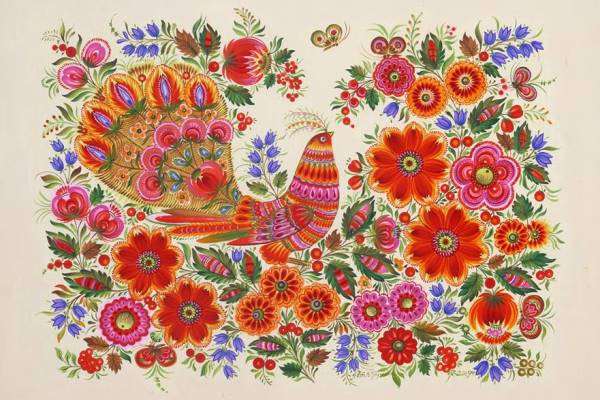
A petrykivka artist’s most important tools are her hands and her cat. To paint the intricate, colorful motifs of this traditional form of Ukrainian folk art, it’s essential to combine bold strokes with delicate ones. The tip of one’s finger might be used to create a cluster of round berries, a mass of dahlia petals or a tangle of oak leaves. But for the fine tendrils and feathers adorning roosters and cuckoo birds, classical symbols with complex meaning, a painter turns to a brush made of cat hair. “The cat first has to agree to give you some fur,” says Natalia Rybak, the artist at the Petrykivka Center for Folk Art, as she shows me the local art collection. “Not all do.”

petrykivka

Petrykivsky painting or “petrykivka” is one of many forms of ancient Ukrainian decorative arts. Its name is derived from the place of its origin, the village of Petrykivka in Dnipropetrovsk region, and it is closely tied to the Cossack tradition. Cossacks were members of the democratic communities that since the 15th century started forming into a loose federation in southern-central Ukraine. Independent from the neighboring states, the Cossack federation offered social freedoms and protection, thus drawing an ever increasing number of people from other regions to its villages. South-east of Kyiv, Petrykivka was established in the 17th century as the wintering ground for the Cossack divisions that spent the rest of the year in the areas around the lower Dnieper River. Even after the Cossackdom was destroyed by the Russian tsars in the 18th century, many former strongholds, such as Petrykivka, retained enough autonomy to develop their traditional crafts.

Continue reading →

An Evening of Bounty

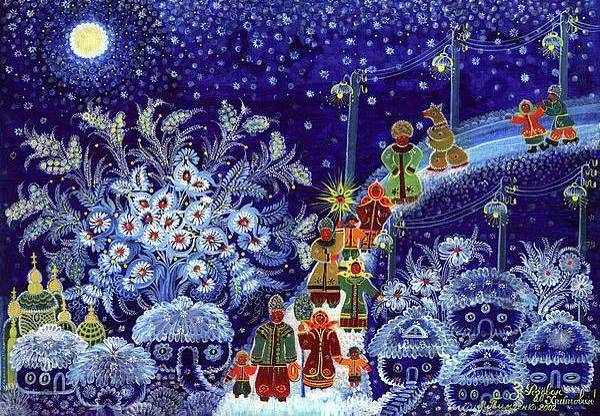
If you’ve ever sung or listened to “Carol of the Bells”, you’ve indirectly partaken in one of the oldest Ukrainian traditions of shchedrivky. The old style New Year’s Eve on January 13th is called Shchedriy Vechir, which means Bountiful or Generous Evening, and part of the celebration includes young women and men visiting their neighbors and singing shchedrivky, couplets wishing good fortune, health and much of bounty in the new year. The most famous song associated with Shchedriy Vechir is “Schedryk” (Щедрик), which was arranged by Ukrainian composer Mykola Leontovych in 1916 and later adapted by Peter Wilhousky as an English Christmas carol, “Carol of the Bells”.

ukrainian christmas

Old traditions are closely intertwined with the customs. Shchedriy Vechir also has the alternative name of Malanka in honor of Saint Melania the Younger whose feast is celebrated on the same day. But the old, pre-Christian customs color the festivities.

Different from carols, which are performed starting on Christmas Eve on January 6th and until the Epiphany on January 19th (the Ukrainian Orthodox calendar still follows the one established by Julius Cesar), shchedrivky focuses on the bounty of nature. The original Ukrainian lyrics for “Carol of the Bells,” for instance, tell the story of a swallow visiting a household and describing all of the rich gifts the family is to see in the spring.

Continue reading →

Uzvar : Ukrainian Spiced Fruit Compote

On January 6th my house smells like dried apricots and honey. It’s the Orthodox Christmas Eve, which in Ukrainian is called Svyata Vecherya, the Holy Supper, and two dishes central to it are kutya and uzvar. I have written about kutya already, but uzvar deserves special mention, because this spiced fruit compote is not only delicious, it has a heady perfume.

uzvar1

Uzvar is not only paired with kutya for the Ukrainian Christmas and Easter, it’s a favorite winter dessert in my family. It’s simple, healthy and can be varied based on what’s available in the cupboard. I can still picture my great-grandfather, Sergiy, laying out sliced apricots to dry on the roof of the garden shed and smoking plums over cherry wood. “For uzvar in the winter,” he would say, while turning the dark, jammy fruit.

Continue reading →

Wildflower Walk on The Eve of Ivan Kupala

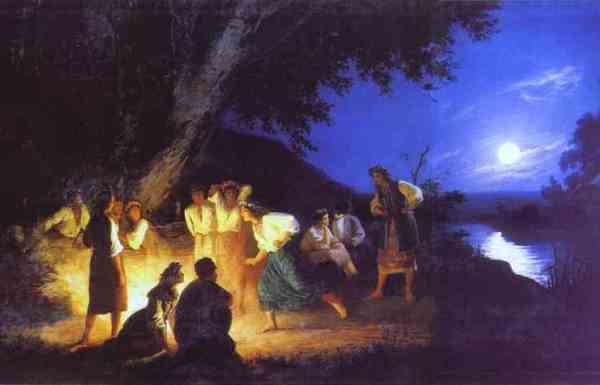
Bonfires are being prepared on the sandy beach lining the Vorskla, a river that cuts Poltava in half and hugs our hamlet within the city’s suburbs. One group of girls is busy weaving wreaths from wild flowers. Heaps of daisies, yarrow and cornflowers are spread out on the ground around them. Further along the bank, grills are being set up, and people are staking out spots with towels and empty crates. It is still early enough, several hours before the sun takes a dip in the river. The scent of hot sand, hay, wild thyme, cigarette smoke and water lilies hangs heavy in the still air. We are waiting for Ivan Kupala’s Eve.

kupala

Ivan Kupala is the Slavic version of the midsummer festival marking the summer solstice. According to the old style Julian calendar used by the Orthodox Church, it’s celebrated on the night of 6/7 July in Ukraine. (In neighboring Poland, Noc Kupały, just like the Swedish midsummer celebrations, takes place on 23/24 June.) Ivan means John (as in John the Baptist) and Kupala comes from the Slavic word for bathing. Although Christian traditions are woven into the festival, the roots are clearly pagan. Water and fire intertwine in various rites, and the river is worshiped as much as the saint himself. Today, the celebrations may involve more beer and barbecue than romantic rituals, but women still float wreaths in the streams to divine their future. Candles are still lit on the river bank. Couples still jump over the bonfire to test the strength of their relationship.


Continue reading →

As Seen On

Design by cre8d
© Copyright 2005-2026 Bois de Jasmin. All rights reserved. Privacy Policy