ukrainian tales: 13 posts

An Evening of Bounty

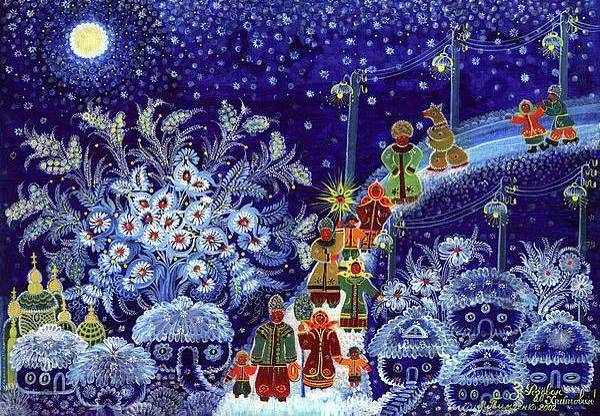
If you’ve ever sung or listened to “Carol of the Bells”, you’ve indirectly partaken in one of the oldest Ukrainian traditions of shchedrivky. The old style New Year’s Eve on January 13th is called Shchedriy Vechir, which means Bountiful or Generous Evening, and part of the celebration includes young women and men visiting their neighbors and singing shchedrivky, couplets wishing good fortune, health and much of bounty in the new year. The most famous song associated with Shchedriy Vechir is “Schedryk” (Щедрик), which was arranged by Ukrainian composer Mykola Leontovych in 1916 and later adapted by Peter Wilhousky as an English Christmas carol, “Carol of the Bells”.
ukrainian christmas

Old traditions are closely intertwined with the customs. Shchedriy Vechir also has the alternative name of Malanka in honor of Saint Melania the Younger whose feast is celebrated on the same day. But the old, pre-Christian customs color the festivities.

Different from carols, which are performed starting on Christmas Eve on January 6th and until the Epiphany on January 19th (the Ukrainian Orthodox calendar still follows the one established by Julius Cesar), shchedrivky focuses on the bounty of nature. The original Ukrainian lyrics for “Carol of the Bells,” for instance, tell the story of a swallow visiting a household and describing all of the rich gifts the family is to see in the spring.
Continue reading →

Wildflower Walk on The Eve of Ivan Kupala

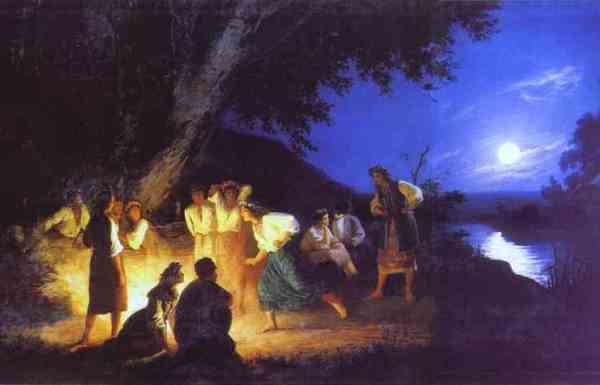
Bonfires are being prepared on the sandy beach lining the Vorskla, a river that cuts Poltava in half and hugs our hamlet within the city’s suburbs. One group of girls is busy weaving wreaths from wild flowers. Heaps of daisies, yarrow and cornflowers are spread out on the ground around them. Further along the bank, grills are being set up, and people are staking out spots with towels and empty crates. It is still early enough, several hours before the sun takes a dip in the river. The scent of hot sand, hay, wild thyme, cigarette smoke and water lilies hangs heavy in the still air. We are waiting for Ivan Kupala’s Eve.

kupala

Ivan Kupala is the Slavic version of the midsummer festival marking the summer solstice. According to the old style Julian calendar used by the Orthodox Church, it’s celebrated on the night of 6/7 July in Ukraine. (In neighboring Poland, Noc Kupały, just like the Swedish midsummer celebrations, takes place on 23/24 June.) Ivan means John (as in John the Baptist) and Kupala comes from the Slavic word for bathing. Although Christian traditions are woven into the festival, the roots are clearly pagan. Water and fire intertwine in various rites, and the river is worshiped as much as the saint himself. Today, the celebrations may involve more beer and barbecue than romantic rituals, but women still float wreaths in the streams to divine their future. Candles are still lit on the river bank. Couples still jump over the bonfire to test the strength of their relationship.

Continue reading →

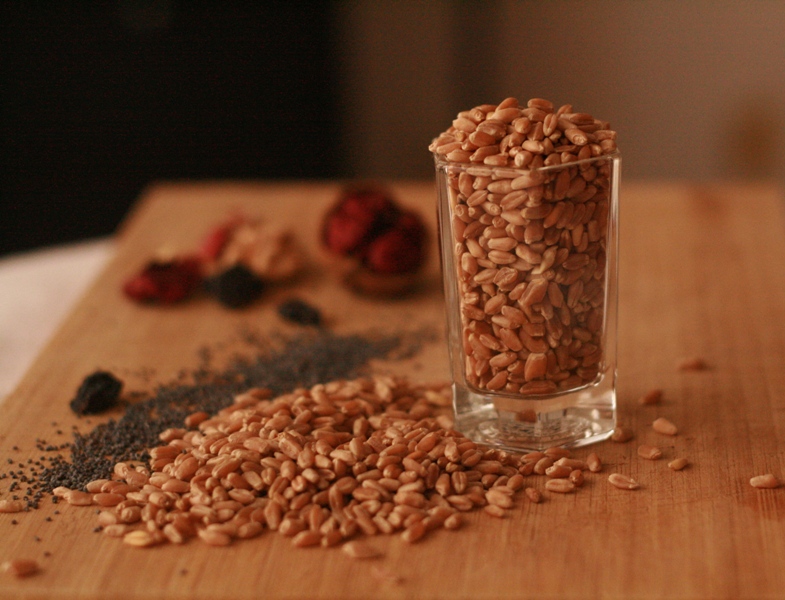
Ukrainian Wheat Berry and Poppyseed Pudding Recipe (Kutya, Kutia)

Wheat and poppyseeds

It is a quiet afternoon on Christmas Eve. I check on the last minute dinner preparations, light up the Christmas tree and take out my old mortar and pestle. Although I know that the food processor will be much faster and easier, there is something special about doing things the old way. As I pound the poppyseeds, the rhythmic movement of the pestle transforms the tiny grey-blue grains into a violet hued mousse. The aroma is nutty at first, then milky and sweet, like fresh marzipan. I want to dip my finger into the creamy paste; it must taste as delicious as it smells.

It takes all of my willpower to resist because on Orthodox Christmas Eve, the Advent fast can only be broken when the first star rises. Instead I continue to work, my body is here in this messy apartment—I still need to clean up before the evening feast—but my mind is with my grandmother on the other side of the ocean who has probably done the same thing earlier today. Kutya—or kutia, kolivo, colivă, koliva, sochivo, as this wheatberry pudding with poppyseeds is known in different parts of Eastern Europe—brings us closer together than any modern means of communication.

Continue reading →

As Seen On

Design by cre8d
© Copyright 2005-2026 Bois de Jasmin. All rights reserved. Privacy Policy