ukrainian tales: 13 posts

Easter Eggs Colored With Onion Skins

I see the Easter color palette as yellow, violet, green, and sienna. Yellow is from the saffron tinted paska, a vanilla scented brioche we traditionally make for Easter Sunday. Violet is from the candied flowers we use to decorate it. Green is from the dill and cucumber salad that must accompany the roast pork. Sienna, on the other hand, is from the color of Easter eggs. It’s a rich hue, between the reds of Sienna frescoes and the brown of sandalwood. This color is completely natural and making it is very easy. All you need is a few handfuls of onion skins.
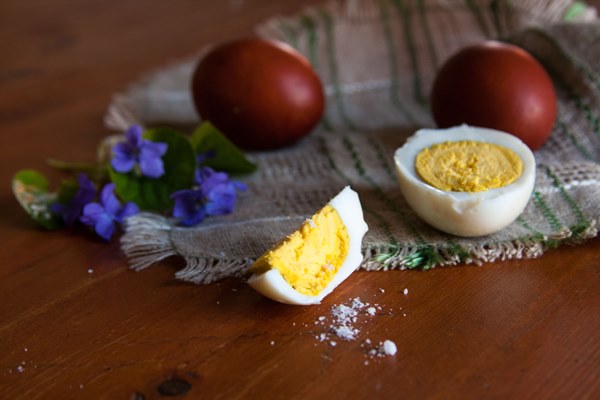
My grandmother starts collecting onion skins a few months before Easter, but she colors dozens of eggs. Most of us need no more than a few onions, although the more skins you have, the darker the color will be. It also follows that the darker the onion skins, the more intense the shade of sienna.
Continue reading →

Petrykivka and Gogol : Colors and Scents

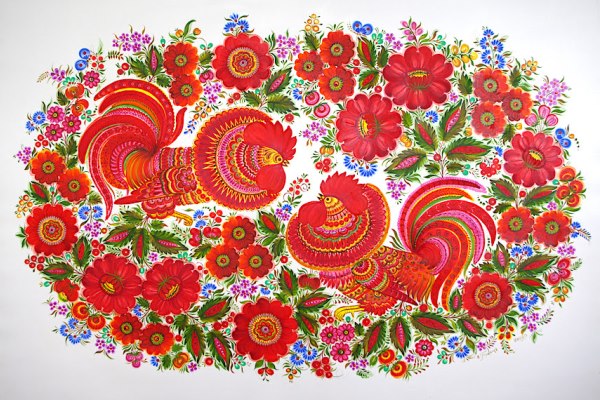
The colors and images of Petrykivka, one of the traditional Ukrainian arts, are vivid and joyous. Fire birds take flight among branches laden with fruit and fantasy blossoms. The artists believed that such colorful images protect people from evil spirits, and looking at the complex and happy ornaments of Petrykivka I can’t help thinking that there is something to the idea of art as talisman.

Petrykivka is considered as Intangible Cultural Heritage of Humanity by UNESCO, and the village of Petrykivka in the Dnipropetrovsk region still boasts many artists. I wrote about my visit two years ago, and anyone can tour the art studios, take a class or simply admire the paintings. Those of you in New York, however, have a unique chance to experience this art in person as The Ukrainian Institute of America hosts the exhibit Petrykivka: A Ukrainian Folk Phenomenon and Living Tradition from April 8 to April 30. The collection presented is based on discoveries by Natalie Pawlenko and Yuri Mischenko and features 47 paintings by some of the most renowned Petrykivka artists.

Continue reading →

The Passion of Johann Georg Pinsel

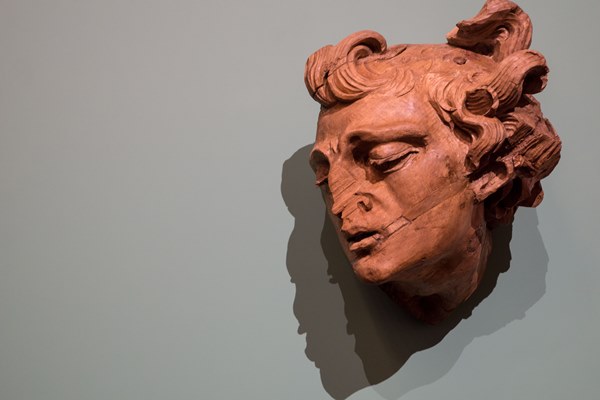
It’s not often that a sculptor causes me to crisscross Europe in search of his traces. But Johann Georg Pinsel did just that. I took rickety marshrutka buses to distant Ukrainian villages to see his work at local churches. I visited many a palace where fragments of his sculptures were displayed–a wing of an angel, a headless saint, a saint motioning one to come closer and listen to the revelation. Finally, I made it to Lviv, a western Ukrainian city, and later to Vienna, the center that once exerted considerable political power over Lviv. These journeys spanned almost a year, intertwined as they were around other trips and exploration, but somehow, Pinsel, a mysterious 18th century master, was the leitmotif.

Very little is known about Pinsel. His name was only established with certainty in the 1990s. Where was he born? With whom he did study? The area where he chose to work was the Lviv region, at the time a part of the Polish-Lithuanian Commonwealth and after the first Partition of Poland in 1772, a part of the Habsburg Empire. After Stalin signed the Molotov-Ribbentrop Pact with Nazi Germany in 1939, these territories once again exchanged hands and ended up in the Soviet Union. This bloody and brutal history had consequences for the master who has been dead for almost two centuries–he was forgotten.

Continue reading →

Stepfather’s Library

When our house in Kyiv was finally sold, the arrangements promised to be uncomplicated–sign some papers, make a few visits to the notary and townhall and arrange for a moving truck. Unexpectedly, the latter turned into a source of some discord, because while my mother was of the opinion that whatever the house held should either be sold or discarded, my grandmother was adamant that every last chair and plate must be salvaged. “Think of the fine dinner sets we bought for your wedding,” she pleaded with mom over the phone. “I always disliked those zaftig Madonnas–and we did get divorced.” “But what about your lovely lacquered desk?” “Soviet satellites sure made some clunky furniture in their day.” And on and on it went scrambling the telephone lines over the Atlantic. But one thing they agreed upon was to collect my stepfather’s library and store it at my grandmother’s.

graffito

At her house, the books stayed in boxes, because for all of my grandmother’s good intentions, the lack of available space in a house already full to the brim with books made it impossible to find another solution. Every time I visited, I would flip open the lid and glance inside, and one day I couldn’t resist and before long all the boxes were unpacked with books arranged in towering piles on the floor around me.

Of the many things that make us–people, places, experiences–some leave the deepest marks. We’re a mosaic of it all, bits and shards of influences shaping our desires, yearnings and dreams. When I think of my stepfather’s library, I’m conscious of a magnetic pull that the eclectic collection of books had on me, taking me far beyond the intentions of its collector.

Continue reading →

Scented Saints, Written Images, Endangered Heritage

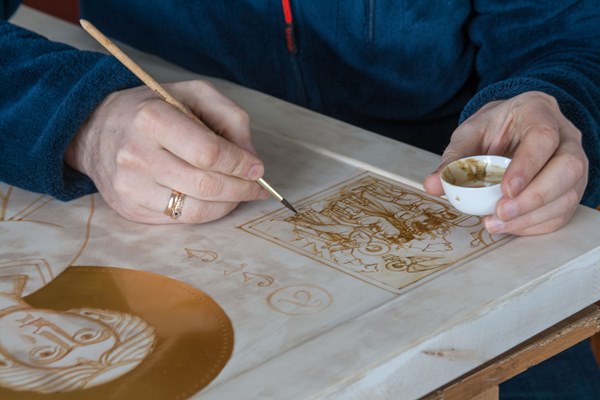
Beautiful sillage is a sign of sainthood in the Orthodox tradition. The fragrance, or mirro (holy myrrh), can be emitted by real life saints, saint’s relics or even icons, painted images of saints. It’s common even today to hear stories of icons shedding myrrh and filling the whole church with the heavenly scent. Such events are called thaumata, a Greek word for wonders. They’re not miracles in the supernatural sense like walking on water or feeding 4,000 with seven loaves of bread. Thaumata are everyday marvels, brief glimpses of the divine through the veil covering us. The same kind of wonder is held responsible for icons, because to paint a saint it’s not enough simply to have artistic skills. One has to be inspired.

lavra-artist-studio1

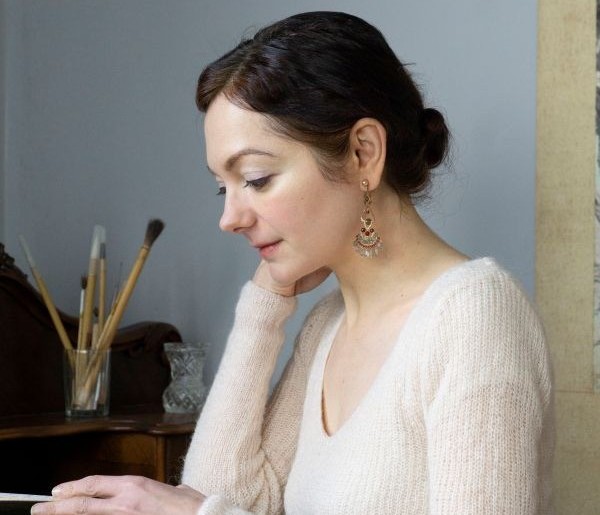
“I didn’t mean to become an icon painter. It was never my goal as an art student. I can’t explain it, but in the end, that’s just what happened,” says Natalya Gladovska, an icon painter at the Lavra Art Studios. My mental image of an icon painter owes much to Tarkovsky’s Andrei Rublev–a somber bearded monk in black robes. Gladovska laughs when I tell her so. She’s warm and bubbly, and everything about her, down to her tendrils of abundant red hair escaping from a loose bun, is filled with energy and verve.

Continue reading →

As Seen On

Design by cre8d
© Copyright 2005-2026 Bois de Jasmin. All rights reserved. Privacy Policy