Ukraine: 66 posts

Petrykivka and Gogol : Colors and Scents

The colors and images of Petrykivka, one of the traditional Ukrainian arts, are vivid and joyous. Fire birds take flight among branches laden with fruit and fantasy blossoms. The artists believed that such colorful images protect people from evil spirits, and looking at the complex and happy ornaments of Petrykivka I can’t help thinking that there is something to the idea of art as talisman.
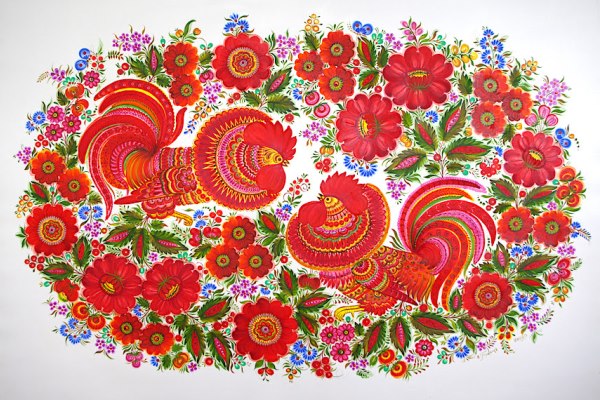
Petrykivka is considered as Intangible Cultural Heritage of Humanity by UNESCO, and the village of Petrykivka in the Dnipropetrovsk region still boasts many artists. I wrote about my visit two years ago, and anyone can tour the art studios, take a class or simply admire the paintings. Those of you in New York, however, have a unique chance to experience this art in person as The Ukrainian Institute of America hosts the exhibit Petrykivka: A Ukrainian Folk Phenomenon and Living Tradition from April 8 to April 30. The collection presented is based on discoveries by Natalie Pawlenko and Yuri Mischenko and features 47 paintings by some of the most renowned Petrykivka artists.
Continue reading →

The Passion of Johann Georg Pinsel

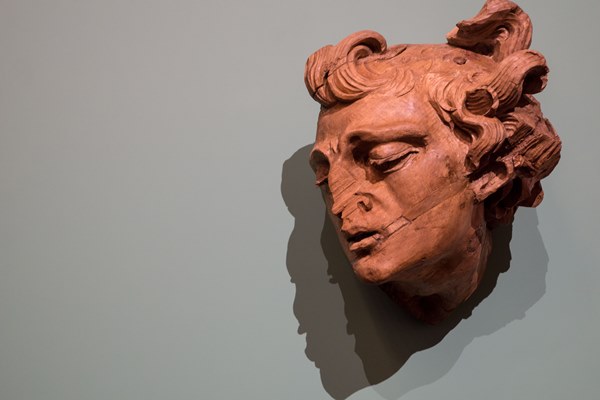
It’s not often that a sculptor causes me to crisscross Europe in search of his traces. But Johann Georg Pinsel did just that. I took rickety marshrutka buses to distant Ukrainian villages to see his work at local churches. I visited many a palace where fragments of his sculptures were displayed–a wing of an angel, a headless saint, a saint motioning one to come closer and listen to the revelation. Finally, I made it to Lviv, a western Ukrainian city, and later to Vienna, the center that once exerted considerable political power over Lviv. These journeys spanned almost a year, intertwined as they were around other trips and exploration, but somehow, Pinsel, a mysterious 18th century master, was the leitmotif.

Very little is known about Pinsel. His name was only established with certainty in the 1990s. Where was he born? With whom he did study? The area where he chose to work was the Lviv region, at the time a part of the Polish-Lithuanian Commonwealth and after the first Partition of Poland in 1772, a part of the Habsburg Empire. After Stalin signed the Molotov-Ribbentrop Pact with Nazi Germany in 1939, these territories once again exchanged hands and ended up in the Soviet Union. This bloody and brutal history had consequences for the master who has been dead for almost two centuries–he was forgotten.

Continue reading →

Rum Raisin Cake

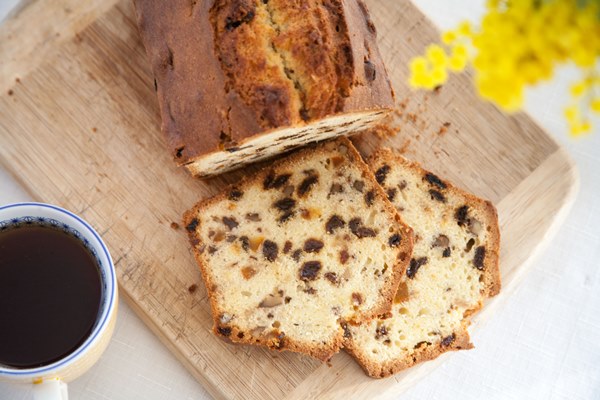
Next to the cookbooks written by my great-grandmother Olena, my other beloved ones are by the Ukrainian food writer Daria Tsvek. I love her voice, advice, and of course, recipes that highlight the flavorful Galician cuisine of Tsvek’s native Lviv. Last week I tried Tsvek’s rum raisin cake that comes from a book called For the Festive Table (До Святкового Столу). Published in 1973, it offers menus and recipes for holidays and celebrations, along with suggestions on how to organize one’s time and host dinner parties.

I picked up the book for my cookbook collection, but I ended up cooking so much from it that I made a photocopy to use in the kitchen. Tsvek’s imaginative and inventive flair fill the pages. She’s able to concoct an elegant feast out of the simplest ingredients, and reading her book I’m not even aware of the endemic Soviet shortages that must have made the task of a recipe writer difficult. Her rum raisin cake turned out to be buttery, crumbly and fragrant, a recipe to add to my baking repertoire.

Continue reading →

White on White : Vyshyvanka and Poltava Embroidery

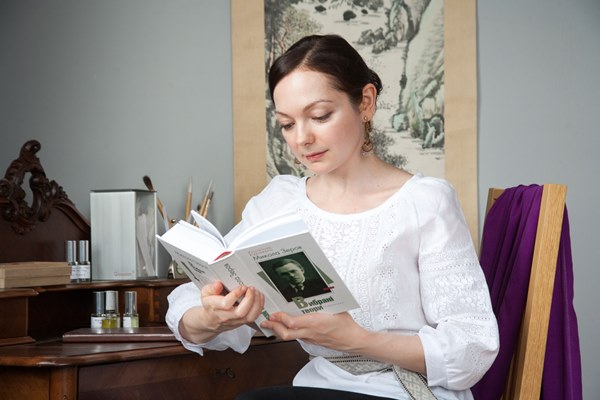
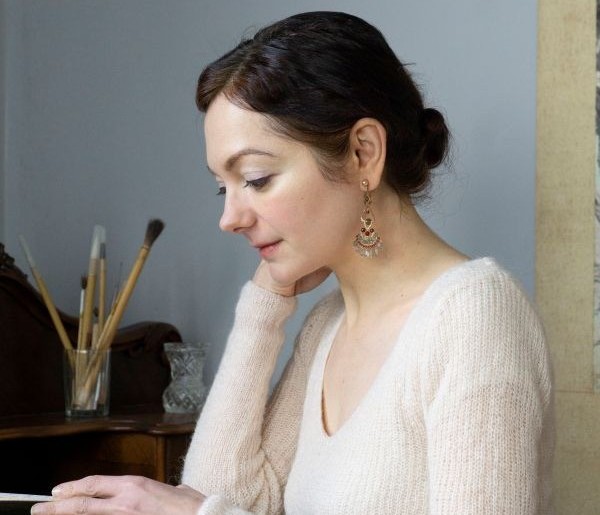
My favorite piece of clothing is a white linen shirt. The tailoring is plain–a straight, loose bodice is framed by a rounded collar and full three-quarter sleeves. In Ukrainian it’s called vyshyvanka, which means “an embroidered shirt,” and indeed the ornamentation is what makes this simple garment unique. The embroidery runs near the collar and falls onto the front of the bodice. It covers the sleeves so thickly that in some parts the fabric is hardly seen. The stitches become the bands of stars, snowflakes, lace and guelder rose, kalyna, a plant that in the symbolic language of Ukrainian art speaks of beauty and happiness. On my shirt, kalyna is abstract enough to be either flowers or berries, and it is intertwined with sinuous leaves and wispy stems. In the artist’s rendering of bile po bilomu, an embroidery technique native to Poltava, only one color is used to capture all of the nuances that in nature are given by a diversity of hues. The color is white.

white-shirt2

Bile po bilomu, or “white on white”, is among the oldest and most complicated embroideries, combining up to twenty different techniques and using drawn thread and counted stitch patterns to create an ornament full of light and shimmer. The artist who created my shirt is Nadia Vakulenko, one of the leading embroidery masters in Ukraine and a teacher at the Reshetylivka Arts Lyceum. Reshetylivka is a small town located in the Poltava region of central Ukraine. I first came here looking for any trace of my great-grandmother Olena and to learn about Ukrainian textile arts. The two aims were closely related, because Olena not only was one of the most creative people in our family, leaving behind several cookbooks and countless knits and embroideries, she also worked at Reshetylivka’s Clara Zetkin carpet factory.

Continue reading →

A Boy With A Fotokor

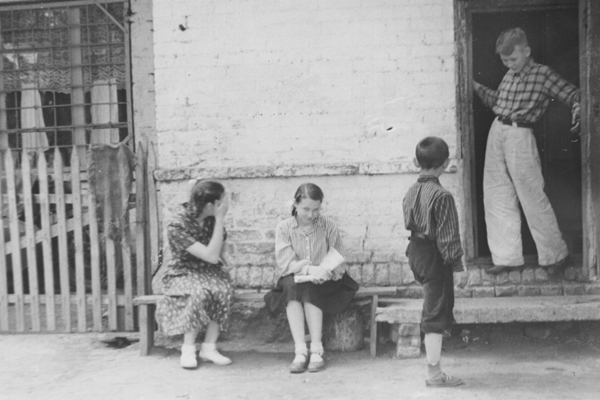
Vladimir, my father’s older brother, developed a passion for photography in unconventional circumstances. Having survived polio, which he caught during World War II, Vladimir suddenly couldn’t move. The disease had ravaged his muscles, leaving him crippled, and while he couldn’t join other children playing, he observed their games from his chair. Then a neighbor, a military captain, gave him his first camera. It was a Fotokor-1, a folding bed plate film camera from 1934, and taking a cue from its name–Fotokor means “photo journalist”, foto korrespondent in Russian–a thirteen year old boy began to photograph everything around him. Eventually, Vladimir grew strong enough to move around unaided, but photography has remained his lifelong interest, which he passed on to me.


girls

This is the Kyiv of the early 1950s. Vladimir takes pictures in the streets of the city–of girls jumping rope, of boys teasing girls, of girls taunting boys, of boys doing naughty things, of soldiers marching, of women waiting in line, of kids having fun, of life as it carries on in a place still marked by war. The photos of Vladimir himself were taken by his younger brother, Valery, although he directed the composition. A small selection I made for you gives a unique, candid glimpse into the Soviet Union of the postwar period as well as the world of one feisty boy.

Continue reading →

As Seen On

Design by cre8d
© Copyright 2005-2026 Bois de Jasmin. All rights reserved. Privacy Policy