Corsican Eucalyptus and the Scent of the Maquis

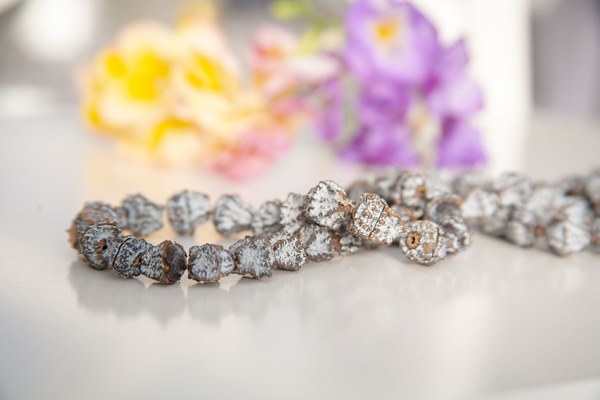
A few years ago I met a woman who talked about her fiendishly complex emigration from Russia to Israel in the ’80s and how instead of Jerusalem she ended up living for a year in Ajaccio, the capital of Corsica. I asked what Corsica was like, my own mental image comprised mostly of Napoleon, the French Foreign Legion, and Laetitia Casta. She reflected for a moment and then said that it smelled heavenly. She meant the smell of the maquis. Since then I’ve been obsessed with the maquis, or as it’s known in Corsican, machja.

In Corsica, the maquis is ever-present–this wild scrubland vegetation covers nearly 20% of the island. Even when you don’t see it, it fleets before you in bits of folklore and stories. For instance, the guerilla fighters of the French Resistance in World War II were called maquisards, from the maquis (pronounced in French as ​[maˈki]) that reach up to 10 feet and make for an ideal hiding place. The maquis provides food, medicine, and lore. The scrubland starts at the sea coast–le maquis bas, climbs higher–le maquis moyen, and clings to the mountains–le maquis haut. These low, middle, and high maquis are woven of more than 2,500 varieties of wild plants, and their aromas build up slowly like a pyramid of a perfectly constructed perfume.

Continue reading →

Favorite Perfume Books to learn about history, science, and techniques

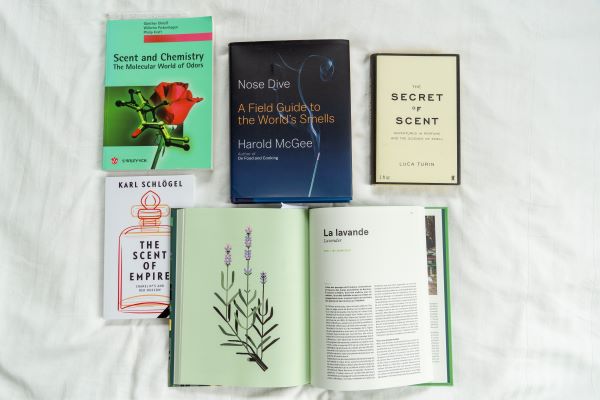
Whenever I’m asked about my favorite books, two parallel thoughts flash through my mind–how much time do you have to listen to me and which are my favorite books. As someone who reads in all genres and on all topics, I have difficulty pairing down my favorites to to a small-talk appropriate list. However, when it comes to perfume books, I have no difficulty answering the question; my most read books are always within reach. Today, I will start with a list of books that I use for reference. I read them cover to cover and dip into chapters at random to learn about perfumery techniques, styles, or the fragrance industry.

Nose Dive: A Field Guide to the World’s Smells by Harold McGee

I first talked to Harold McGee about this book project more than ten years ago, but I believe that it took him even longer to research it. The wait has been worth it. McGee’s erudition sparkles on every page, and you can open the book on any chapter and find something new about aromas, molecules, emotions — and your own nose. It’s a study of olfaction as well as the world as we experience it through our senses. McGee weaves his personal experiences throughout his discussions, which gives Nose Dive its rich, layered quality. If you’re familiar with McGee’s writings on food and the science of cooking, you don’t need me to advertise this book further. Highly recommended.

Continue reading →

Favorite Scented Candles for Daydreaming

I have a weakness for scented candles and the autumn-winter season brings many temptations. L’Artisan Parfumeur’s collection, for instance, offers plenty of reverie-inspiring options from  jasmine (Souffle de Jasmin) to saffron (Voyage à Constantinople) and more. The candles burn cleanly, without smoke or soot, and the scent lingers for a few hours in the air. These days I’m lighting Brise de Mimosa whenever I crave sunshine and verve. This candle is redolent of mimosa branches, green leaves, and violet flowers. The aroma of mimosa is delicate and complex, but Brise de Mimosa captures it well; it only takes a few minutes to fill my room with the scent of Provence.
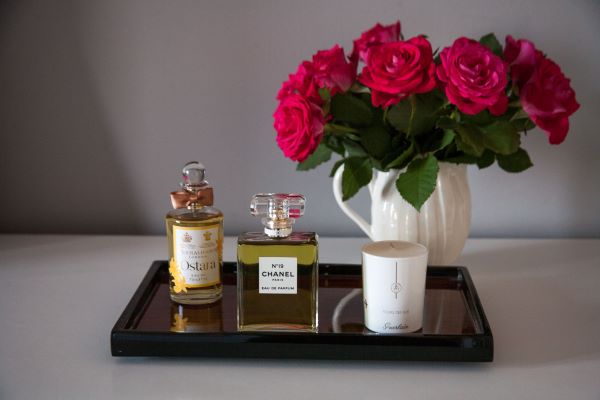
If not mimosa, then I choose to festoon my room with the garlands of violets by lighting Molton Brown’s Exquisite Vanilla & Violet Flower candle.  True to its name, it smells of violet bonbon and fresh flowers and green notes make it airy. The lavender-tinted glass makes it a charming decorative item.

Another elegant option is Midi Eternel from the niche perfume house of Sulékó. Based in Paris, Sulékó draws on the French perfume traditions and the Slavic heritage of its founder, Anastasia Sokolow. The perfume collection, for instance, was inspired by the Russian fairy tales, but the candle is a tribute to the south of France and its heady aromas. The main accent is green, with a touch of myrtle, rosemary, and pine needles for brightness. The salty nuance that becomes obvious the longer the candle burns evokes the scents of sea breeze and driftwood. Midi Eternel has a rejuvenating, crisp fragrance, perfect for those who prefer their room scents unsweetened.

Byredo’s Tree House candle is similarly polished. The main chord includes cedarwood, sandalwood, and hay, with allspice and myrrh adding darker, warmer layers. It was inspired by the creations of the Japanese wood master Takashi Kobayashi and his tree houses. Byredo’s idea captures the aromas of polished woods in a candle form. Even after the candle is snuffed out, the peppery, balsamic scent floats in the air, evoking glistening wood shavings in different shades of amber.

Pro tip: To make any candle release its scents evenly, burn it for no longer than two hours at the time and trim the wick on regular basis. It will delight you longer and keep its scent until the last drop of wax.

What are your favorite candles and home scents?

Photography by Bois de Jasmin
3 Perfume Trends for 2021 and beyond

Today’s topic is trends in fine fragrance, air care (candles, diffusers, room sprays,) and body care. Based on my professional experience and studies of consumer reports, I will share three key trends that define 2021/2022. First of all, a note on how trends are compiled, because it’s an obscure topic to most people outside of the perfume industry–and to many people in the industry as well. No crystal balls are involved; it’s all about numbers.


To put it simply, agencies like NPD and Mintel track sales of different products, and based on the sales volumes and types of products, they make inferences about consumer preferences. Similar, perfume companies research trends and preferences, based on the sales of their products and those of their competitors. Understanding trends is important for brands in today’s crowded market not so much to make the whole world smell of green tea and peaches but to see where the tastes of consumers lie. What are they interested in? What kind of products appeal to them?

The insights I share below are based on my professional experience as a researcher and the information I come across as part of my day-to-day work as an industry analyst. I will explain each trend and give a few examples. You can watch the video or read my report below.

Continue reading →

5 Light and Radiant Jasmine Perfumes

It always surprises me that jasmine, one of the most luminous floral notes, is considered to be heavy and smothering. Then I realize that while my attention is drawn to its apricot jam and green tea facets, many other people can’t get past the indolic, horse-sweat undercurrent. Some of us are sensitive to animalic notes. Others don’t care for the mothball-tanginess that indoles suggest. Yet even more people don’t have the chance to experience natural jasmine, but rather form their opinion based on synthetic jasmine fragrances that don’t even attempt to mimic the real thing. And when we don’t like something, we call it  “heavy.”

I love jasmine in all of its interpretations, and in my new film, I would like to defend this iconic floral ingredient and explain what makes it unique. I talk about the difference between jasmine grandiflorum and jasmine sambac and explain how this note is used in fragrances. Since I appreciate that not everyone enjoys rich white florals, I selected the gauziest, most effervescent jasmine fragrances I could find to illustrate my explanations.

Continue reading →

As Seen On

Design by cre8d
© Copyright 2005-2026 Bois de Jasmin. All rights reserved. Privacy Policy