Perfume 101: 517 posts

Here you can find how to guides to selecting, testing and enjoying scents. Also includes are the lists of our top favorite perfumes for different occasions and articles covering all range of topics related to fragrance. If you’re curious to step inside a perfume lab (or even become an industry professional), this group of essays will be of interest.

The Loud Comeback of Perfume : Why Big Scents Are Back

Once whispered on wrists and hidden in scarves, fragrance is back to making noise — and not in a polite way. Think clouds of tuberose in the metro, cherry-vanilla fogs in coffee shops, amber-woods ambushing you in elevators. After years of “skin scents” and “sexy clean,” the pendulum has swung. Subtlety is out. Sillage is back.
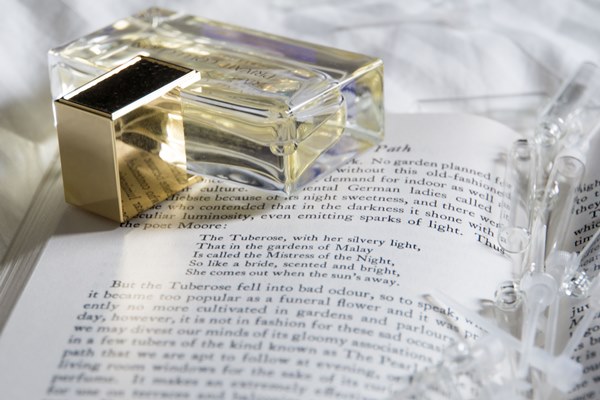
If this feels familiar, it’s because it is. The 1980s were one long olfactory rock concert. Yves Saint Laurent Opium, Dior Poison, Giorgio Beverly Hills — perfumes that didn’t so much linger as colonize the air. They came with wide shoulders, red lipstick, and the unapologetic mission to announce: I was here and you will remember me.

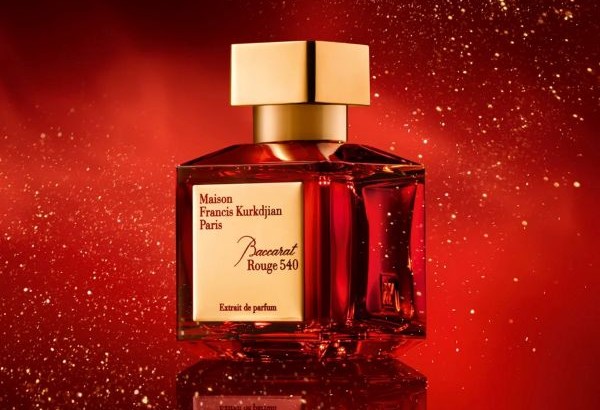
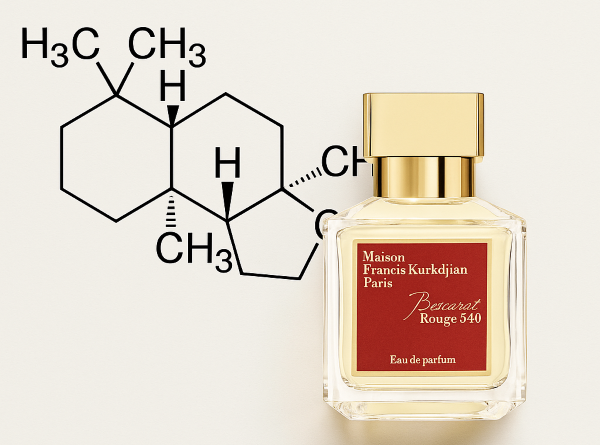
Today’s power scents dress differently. They may be gender-neutral like Marc-Antoine Barrois Ganymede or artisanal like Maison Francis Kurkdjian Baccarat Rouge 540. But the intent is the same: to make a statement.
Continue reading →

Why Some People Smell Nothing in Baccarat Rouge 540

Maison Francis Kurkdjian Baccarat Rouge 540? Oh yes, it’s everywhere. You can smell it in elevators, cafés, and occasionally on buses that really shouldn’t be carrying anything so expensive. Except some people swear they smell…nothing. They sniff, they spray, they press their wrist to their nose—and all they get is disappointment. Meanwhile, the rest of us are quietly choking on what feels like a candyfloss thundercloud.

So, what’s going on? Baccarat Rouge 540 leans heavily on ambroxan (amber-woody), Veltol/maltol (cotton candy), and other woody synthetics. These are all potent materials. They’re also molecules that many people simply can’t smell.

It’s called selective anosmia. Up to 20% of the population is “blind” to certain musks, ambers, or woods. If your olfactory receptors don’t recognize ambroxan, you’ll get nothing.

Continue reading →

Maison Francis Kurkdjian Baccarat Rouge 540 : Perfume Review

44444

Maison Francis Kurkdjian Baccarat Rouge 540 is a trickster of a perfume. I first smelled it not in a gilded boutique, but in a marshrutka in Poltava. Outside, the streets were lined with sandbags and the windows blast-proofed; inside, we were wedged together under the scent of stale cigarette smoke and damp wool. And then—floating above it all—came this unmistakable cloud of Baccarat Rouge 540, as if the bus had driven straight through the lobby of the Ritz.

That shimmering force field comes from a complex amber-woody accord supported by oak moss and Veltol. Here, it’s used at architecture-level dosage, lending a dry, vibrating presence that refuses to fade. One structural pillar is ambroxan, which amplifies and diffuses the perfume’s sweetness. There is also Veltol, the cotton-candy molecule that lends a burnt caramel accent to the amber accord. Together, the notes create an amber woody-mineral gourmand hybrid, sweet but not edible, crystalline rather than creamy. The effect is elegant and gentle on first inhale, yet its projection and longevity defy all logic.

Continue reading →

Writing About Perfume as the World Burns

One summer evening in Kharkiv, I was writing a perfume review when the air raid sirens began. The sound was now part of the city’s fabric, as ordinary and as terrible as the smell of bread from the bakery on the corner. I paused, listened for the thud that might follow, and then turned back to my draft. A question pressed against me: What am I doing, writing about perfume as the world burns?

It’s a question I’ve asked myself many times over the past years. Perfume can seem like a frivolity, a luxury for calmer days. But the more I’ve lived through, the more convinced I am that it is not just a product. Perfume is a cultural layer, a record of our rituals, desires, migrations, and exchanges. It carries the memory of places and the touch of history on the skin. Every bottle is both a work of art and a fragment of anthropology.

Continue reading →

The Scented Archive: Why Smell Belongs in Our History

We rarely think of scent as part of archives and historical records. The past is treated as visual, textual, factual — something we read or look at. But our lives are full of smells: the minty tang of toothpaste, burnt toast, the brine of sweat on public transportation, the coolness of a florist shop we pass on the way to work. These are not incidental. They are the scaffolding of memory. What we forget with our minds, the nose remembers.

I think often about this partial amnesia. What has been lost because it couldn’t be catalogued? How many women’s lives, marked by the scent of boiled milk, starch, soap, lily of the valley, have slipped away without trace? How many communities vanished, taking with them their voices, customs, foods — and scents. In Ukraine, I witnessed towns being flattened, homes scorched, and with them the quiet archives of everyday life. And elsewhere too, in places like Gaza, Sudan, Yemen, Syria, wars and displacements continue to erase not only histories but atmospheres, the very breath of places.

Continue reading →

As Seen On

Design by cre8d
© Copyright 2005-2026 Bois de Jasmin. All rights reserved. Privacy Policy