perfumery business: 17 posts

How Many Roses Does it Take to Make a Drop of Essence?

Here is a bit of perfume math: 4 tons of roses = 1 600 000 rose blossoms = 1 kg of rose oil. No wonder rose oil is one of the most expensive essences, and a kilo of golden liquid will fetch around $7000. The cosmetics company Lush uploaded a terrific video about the rose harvest in Senir, a town in the Turkish province of Antalya, and it shows all stages of rose oil production, from handpicking the blossoms to turning them into the essence. The video also helpfully explains the difference between rose oil and rose absolute.

Update 2021: The video is no longer available, but I suggest searching YouTube for other videos of rose harvests in Turkey, Bulgaria, and France.

How Balsams are Harvested for Perfume

Peru Balsam is one of the workhorses in a perfumer’s palette providing a solid base note and voluptuous drydown. It’s a resinous material that, depending on the extraction method and provenance, can smell either warm and ambery or smoky and spicy. When you enjoy perfumes like Hermès  Elixir des Merveilles, Serge Lutens Amber Sultan, or Yves Saint Laurent Opium, you’re admiring the complexity of this interesting note.

I have enjoyed experimenting with Peru balsam ever since my early days in perfumery school, but it was only last year that I discovered how it’s grown and collected. The process hasn’t changed much since antiquity and it’s fascinating. I had been meaning to write about it when I discovered something even better. A company, Nobs Naturals, uploaded a video on Youtube showing how Peru balsam is gathered and you can see for yourself what it’s like.

Nobs Naturals provided the following explanation:

“A piece of bark measuring about 36 by 6 inches is removed starting from the lower part of the tree trunk. The tree can be harvested at all heights of its trunk, which can have a height of over 30 meters. The exposed area is then burnt with a torch, and then a piece of dry cloth is placed on the wound to absorb the oleoresin produced by the tree in response to the treatment. After a month and a half the cloth is recovered and the oleoresin is extracted from it by boiling in water for many hours and then passage through a rustic wooden press. The bark removed from the tree trunk is subject to a similar process.”

Styrax, benzoin and many other balsamic-resinous materials are collected in a similar manner.

Extra: Tolu Balsam, Benzoin, Styrax and Other Oriental Balsamic Notes

Copyright Protection? Not For Perfume!

On December 10, 2013, the Court of Cassation, the highest court in the French judiciary, confirmed the first judgment of the Court of Appeal of Nancy and its constant jurisprudence since 2006 that perfume is not eligible to be protected under copyright law. The case involved L’Oréal suing a company that made and sold products replicating those of its perfume division, Lancôme. While Lancôme offers Trésor, the rival launches La Valeur and so on. The case centered on the perfume, but the other elements of the products–trademark and packaging–were also touched upon.

copyright

In the decision, the court explained that “a form that can be perceived by the senses” (the olfactory sense in this instance) can only be protected as far as it is identifiable with enough precision to be communicated.  It follows then that fragrance, which elaboration process  is not a work of intellect, but rather of technical know-how, doesn’t have a form with these characteristics (identifiable, precise, communicable), and thus cannot benefit from copyright protection. In other words, fragrance is too subjective to be clearly defined.

Continue reading →

How Many Hands Touch Your Bottle of Perfume : Perfumers

The first article in this series described the process through which the perfume brief goes before it ends up on the perfumer’s desk (Brief). Then, my perfumery school classmate and former colleague Lauren gave you a glimpse of what it’s like to be a perfume evaluator (Evaluator). Today, I will describe the role of the perfumer.

If you’re new to this series, I recommend starting with Part 1: Brief.

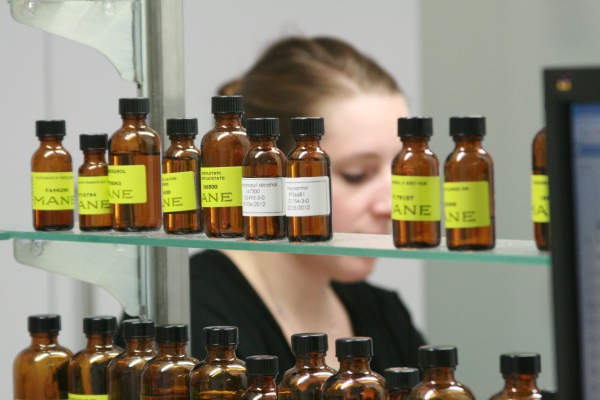
Ever since Frédéric Malle highlighted perfumers by adding their names on the fragrances created for Editions de Parfums, these actors, traditionally consigned to ghost writing scents, have become more prominent. We can find out which nose created our favorite perfume, read about perfumers’ work, and even hear them explain their metier. Names of houses that employ perfumers–International Flavors & Fragrances, Givaudan, Firmenich, Symrise, Mane, Robertet–even show up in the traditional media. Magazines call noses rock stars. Fans queue to meet them at store events. Isn’t then the perfumer the most important person in the process of creating a perfume?

perfume-lab1

Yes and no. With the exception of those who direct their own brands, most perfumers are only one of many groups that influence how a fragrance will smell. Today, it’s hard to speak of a perfumer’s fingerprint on a big brand launch because many fragrances are created as a collaboration among several creators, marketing reps, sales people, and evaluators. In most cases, an individual perfumer may not have a say in the matter and simply has to follow the given direction.

Continue reading →

Do We Have Too Many Launches?

Yes, of course, we  do! Only in 1990, we had 76 new perfumes, this year we have 700 and this doesn’t include the upcoming holiday launches.* Even the consumers are asking the industry to slow down. In various studies done on both sides of the Atlantic women express skepticism and disappointment when it comes to recent releases. “They all smell the same” is a common refrain. While the number of new launches is indisputably high, you can’t blame the malaise of the fragrance industry on the volume alone.

perfume-stand

A couple of weeks ago I was researching materials for a presentation on 1920s fragrances which required me digging in the archives and leafing through lists of long forgotten perfumes. You can get a whiff of the 1920s today through Chanel No 5, Guerlain Shalimar, Caron Nuit de Noël, Molinard Habanita and perhaps 20-3o others, and it might seem as if the fragrance houses were launching one classic after another.

But one look into the Guerlain archives, and you see that in the 1920s the house launched more than 20 different fragrances. There were several variations on identical themes like jasmine, vetiver and leather. At the end of the day, only Shalimar, Liu, and Eau de Fleurs de Cédrat survived.  You can find similar trends from Chanel to Weil.

Continue reading →

As Seen On

Design by cre8d
© Copyright 2005-2026 Bois de Jasmin. All rights reserved. Privacy Policy