May 24, 2005 by in Perfume Notes
Jasmine Perfume Note and Material
It seems fitting to start my reflections by devoting some attention to jasmine, which is not only my favorite fragrance note, but also the most widely used perfume ingredient, be it natural or synthetic. While the rose is “the queen of flowers,” jasmine is indisputably the king.
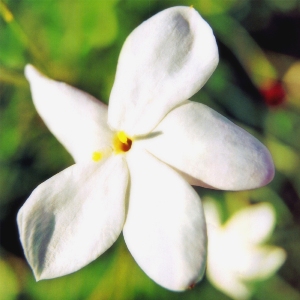
The original habitat of jasmine is considered to be India, which alone possesses about 42 species with various olfactory characteristics. In India, Ghazimpur has traditionally been the center of jasmine cultivation, while in Europe, it was Grasse, France. The jasmine was first cultivated in in Provence in 1548, being a gift of the Arab trade network (Morris 1984, 104). Today, jasmin de Grasse is the most expensive jasmine available, and the only widely available perfume using it is Chanel No 5 extrait de parfum. It is sweeter and fruitier than the more commonly available jasmines from Italy, India, Morocco and Egypt (responsible for 80% of jasmine production).