Perfume 101: 517 posts

Here you can find how to guides to selecting, testing and enjoying scents. Also includes are the lists of our top favorite perfumes for different occasions and articles covering all range of topics related to fragrance. If you’re curious to step inside a perfume lab (or even become an industry professional), this group of essays will be of interest.

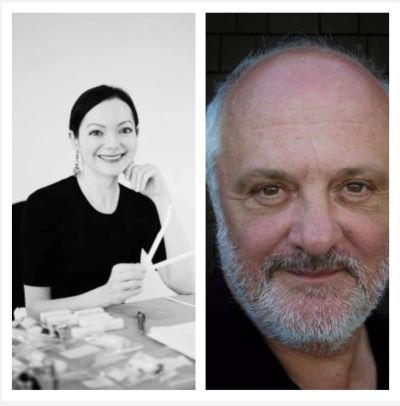
The Art of Perfume Course : Workshop

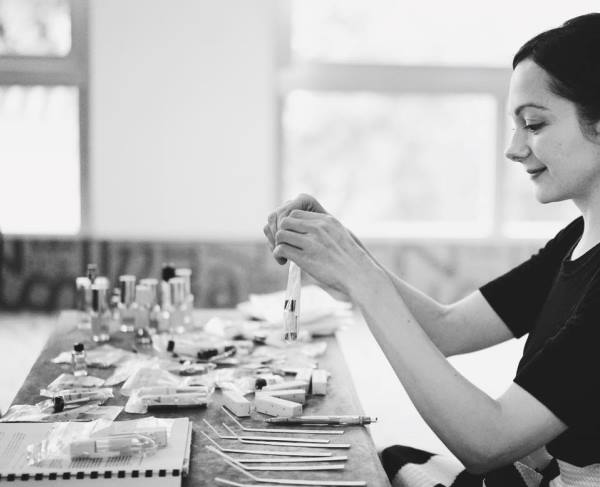
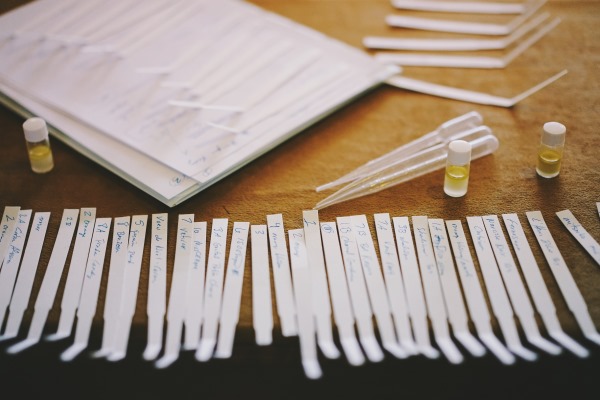
Here is a recap of the three days of our Art of Perfume course: on Day 1 we visited the Edmond Roudnitska garden and explored the International Perfume Museum in Grasse, on Day 2 we learned about perfumes that influenced fragrance history and more, and on Day 3 we applied our newly learned skills to practical exercises.

As I mentioned before, my course was designed with all of the rigor of a professional training program, keeping in mind our time limitations. It takes years to learn how to make a perfume, but one can acquire basic knowledge of raw materials and try simple exercises to see how they interact together. All of this not only helps deepen one’s knowledge of perfumery, but also makes one’s perceptions sharper.

Continue reading →

Warmed by the Sun in Iza

Last month I visited Iza, a village in western Ukraine renowned for its grapevine weaving tradition. Tiny shops lining the roads offered a selection of baskets, boxes, furniture and toys. I walked from one store to another, admiring as much the intricate patterns of braids, stars and coiled loops as the scent of weaving warming in the spring sun.

The fragrance was sweet like vanilla biscuits, with a mellow accent reminiscent of an antique shop–wood shavings, dust and varnish. Have I smelled it before? It seemed familiar to the point of disturbing, like a half-remembered face in the crowd or a word sitting on the tip of the tongue.

Continue reading →

The Art of Perfume : Perfume Techniques and Stories

I already wrote about my most recent perfumery course, covering the first day of our activities, visiting the Edmond Roudnitska garden and exploring the International Perfume Museum in Grasse. Today I’m continuing with our second day, which covered perfume history and professional smelling techniques.

Whenever I hear the phrase “perfume history,” I think of the typical introductory chapter in books on fragrance that start with the Egyptians and the stuff researchers still find in the pyramids. Then a writer might continue with a short homage to the Romans, include a remark on the use of perfume by the bath fearing Europeans in the Middle Ages and with a clear conscience they skip to the brave new world of the 20th century and its Chanels and Guerlains. Perfume history is fascinating stuff, but why is it presented in such a dull manner? I want to do something different.

Continue reading →

The City of Jasmine

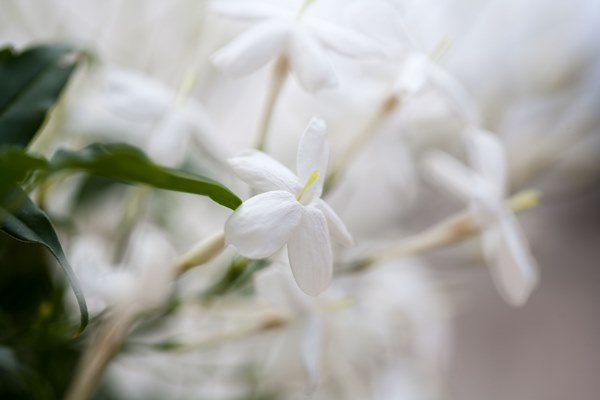
Writer Nizar Qabbani (1923-1998) described his native city of Damascus as “the womb that taught me poetry, taught me creativity, and granted me the alphabet of Jasmine.” Although the most fragrant of roses bears the name rosa damascena, Damascus rose, the Syrian capital is known as Madinat Al Yasmine, the City of ­Jasmine. Each fall it holds a festival in homage of this national flower, with people giving each other stems of jasmine and decorating their home with fragrant blossoms. It was even held in recent years, despite the conflict that left thousands dead and millions displaced, with flowers given to those who lost loved ones.
“A Damascene moon travels through my blood
Nightingales . . . and grain . . . and domes
From Damascus, jasmine begins its whiteness
And fragrances perfume themselves with her scent
From Damascus, water begins . . . for wherever
You lean your head, a stream flows
And poetry is a sparrow spreading its wings
Over Sham . . . and a poet is a voyager,”

writes Qabbani in one of his most renowned poems, A Damascene Moon. He was born in Damascus in 1923 in the old neighborhood of Mi’thnah Al-Shahm, which you encounter time and again in his poems. Qabbani’s poems are romantic and political, erotic and lyrical, breaking conventions and offering a glimpse into his lively, rich imagination. Since 1966 and until his death in 1998, Qabbani has been living abroad, but in his exile he has produced some of his finest poems. The longing for the City of Jasmine gives his words a strong charge, and as I read them, I think of all the places that I miss, all of the colors, scents and voices that make up my memories. As someone who created a fantasy jasmine forest, to replace the real one far away, I feel a poignant kinship with the Syrian poet.

Continue reading →
Chanel, Caron and Guerlain in Bulgakov’s The Master and Margarita

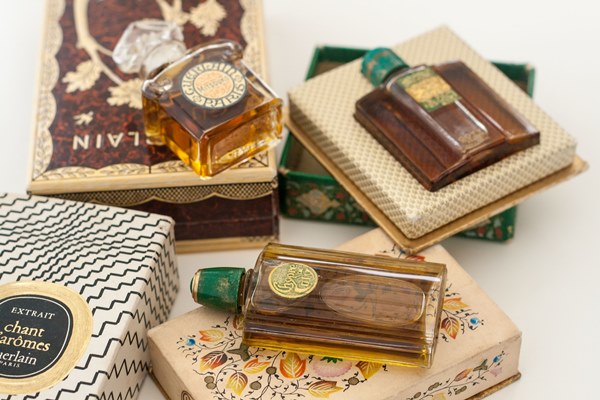
“The first time I encountered a perfume that beguiled me was in the pages of a book. The sultry red-haired witch in Mikhail Bulgakov’s The Master and Margarita enticed women with the promise of “Guerlain, Chanel No 5, Mitsouko, Narcisse Noir, evening gowns, cocktail dresses…” It would be some years before I smelled these perfumes, yet their names left a “baffling but seductive” imprint, just as the novel suggested.”

In my recent FT column, Revisiting Three Perfume Classics, I write about the three legendary perfumes that left their “baffling but seductive” trace in literature and history. They are Chanel No 5, Guerlain Mitsouko and Caron Narcisse Noir. Bulgakov started writing his novel in 1928 and worked on it until his death in 1940. The reason he selected these three perfumes as the lure for the black magic show was because they embodied glamour.

Continue reading →

As Seen On

Design by cre8d
© Copyright 2005-2026 Bois de Jasmin. All rights reserved. Privacy Policy