My Ukraine : On Storytelling and Family


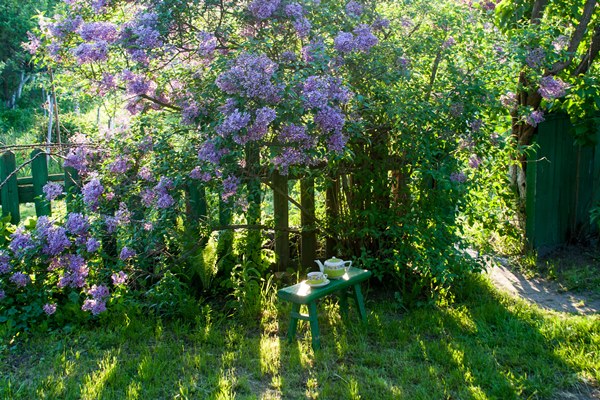
Much of my scent vocabulary comes from Poltava, a town in central Ukraine where I spent the first 15 summers of my life. I was born in the capital city of Kyiv, but Berig, a hamlet near the town of Poltava, is our family nest. My mother’s line can trace its roots to this region as far back as the 17th century. Though in Ukraine’s tumultuous history four centuries are hardly ancient, this land exhorts an inexorable pull on me. Berig is our idea of heaven. I can describe without much effort how many trees are in the orchard and which of the peeling grey shutters has a rusty hook, but I also can recall the exact scent inside the water tank, the damp warmth of the tool shed, and the bitter odor of dandelion flowers.

As you read Bois de Jasmin, you breathe in these scents along with me, because the roots of my jasmine forest, bois de jasmin, are in Berig. When describing the fragrance of carnations and roses, I think of the flowers my great-grandmother grew. They are my olfactive referents. And so I would like to take you to very place that inspired Bois de Jasmin, to my great-grandparents’ house in Berig.
The word paradise comes from the ancient Persian word pairidaēza, “an enclosed garden,” and for a Ukrainian, a cherry orchard is an idea of Eden. It has the same potent connotations as a white picketed fence house in the context of the American dream. It doesn’t mean that all Ukrainians dream of retreating to the village and tending to cherries—no more so than all Americans want to live in the suburbs and obsess over greens lawns—but the image has force beyond its mere components.

In many folk songs, the cherry orchard is where friends meet, families gather for supper and beloved yearn for each other. It is a place of safety and beauty. It evokes all of the things that matter—family, love, friendship, bounty. It’s not a coincidence that one of the most popular works in Ukrainian literature is a short poem by the national bard Taras Shevchenko. Recite the opening lines to any Ukrainian—“A cherry orchard by the house. Above the cherries beetles hum”–and you will see his face light up and his mind travel to his own fantasy garden. “And nightingale their vigil keep,” he murmurs the poem’s romantic coda*.
You can spell it borscht, borshch, or borsch, but by any name, it’s the dish that embodies the essence of Ukrainian food culture–colorful, rich and vibrant. To call it soup wouldn’t be correct, because Ukrainian borscht is a dish more like minestrone, pot-au-feu or cocido in its heartiness. Every region of Ukraine has different varieties of borscht. There is no one authentic recipe, although there are classical versions. Borscht in Lviv in the west of Ukraine is ruby-red and includes small mushroom-filled dumplings; it’s an essential Christmas Eve dish. In the south of Ukraine, borscht is made with fish. The Central Ukrainian-style borscht–the most popular variation–is famous for its sweet-sour flavors. Borscht can be made with beef, pork, chicken, duck, beans, and even fish. It can be vegetarian. It can be soured with tomatoes, beet kvas, vinegar, sour cherries, rhubarb or red currants. It can be flavored with mushrooms or dried plums. It can include white beets and be pale in color. It can be spicy with paprika or suave with sour cream.
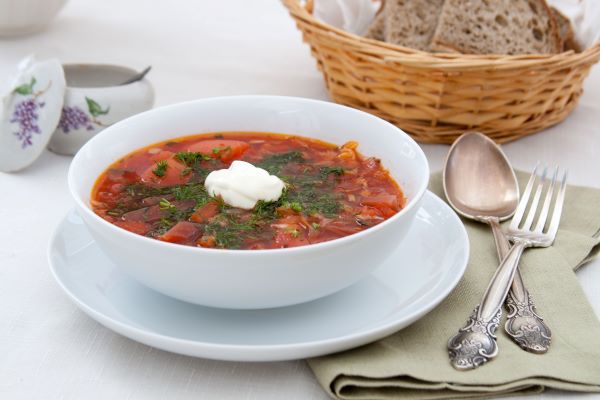
Outside of Eastern Europe, borscht tends to be associated with Russian cooking, since people tend to label everything from the former Soviet Union as Russian. Borscht in different variations is also enjoyed in Poland (barszcz), Lithuania (barščiai) and Romania (borş). Nevertheless, if you think of borscht as soup with beets, cabbage and tinted red with tomatoes, then it’s the Ukrainian version that you have in mind. According to the Russian food historian, Olga Syutkina, that version became popular in Russia at the end of the 18th century, when this dish was introduced on the tsarist army’s menu. Originally, borscht was the food of the peasants, because it was easy to cook in advance and was nutritious enough to be served as a one-dish meal. With the immigration of the Ashkenazi Jewish community to North America, borscht–the English spelling gives away its Yiddish roots–became popular in the New World.
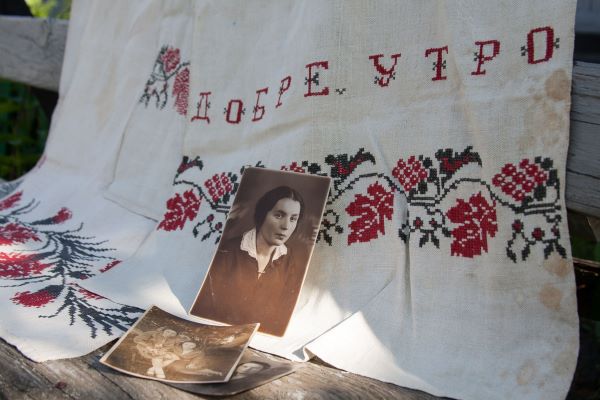
In Ukraine, there is an old tradition of embroidering a rushnyk, a hand towel, during dark periods of one’s life. It matters less what’s embroidered than the process of doing so. Once the rushnyk is done, it’s tied to a tree branch and allowed to decay. This way, people say, one’s worries and dark thoughts become scattered.

I don’t know if my great-grandmother Asya followed this tradition consciously–at any rate, she was far too practical to hang perfectly good fabric in the garden, but she wove her own cloth and embroidered. Even the most ubiquitous items in the house like newspaper holders and bread bags were embellished. Her most beautiful embroideries, however, weren’t meant to be seen. They were her undergarments.