Boris Pasternak : Let’s drop words as gardens drop orange-peel and amber

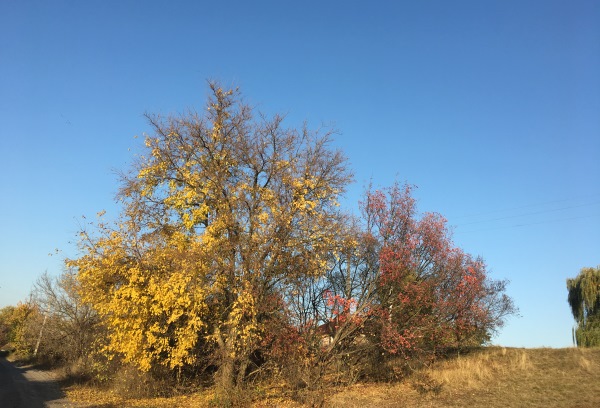
The garden stood still and fragile, ready to drop golden leaves at the gentlest breeze. I woke up early and as I stepped out of the house, I didn’t anticipate the ethereal beauty of autumn. I too stood still, my hand outstretched to pick a red apple forgotten on a bare branch. Fall cast its spell on me, and I didn’t want to shake it off.

The last time I was in Ukraine in autumn was in 1993, but I don’t recall visiting Poltava, the place where my grandmother Valentina lives, at that time. When I still lived in Ukraine, I would usually be in school. Once I was already abroad, I would return only in spring or summer. This spontaneous visit happened because of a series of events out of my control, but as I stood in the orchard filled with golden light, I realized what a gift fate has given me. To experience perfect beauty when one least expects it is after all one of the greatest blessings in life.

Such moments aren’t grand. As Boris Pasternak (1890 – 1960) writes in one of his most moving poems, “life, like an autumn stillness, is all detail.” Noticing these details and capturing them is essential. When people ask me why I find the sense of smell so fascinating, I respond simply–it allows me to pay attention to details. If you notice the scent of fallen leaves, you will also notice the delicate etching of their veins, the lemon yellow hue, the silvery mist that turns the landscape into an impressionist painting, the sound your steps make in a quiet orchard. Your ability to slow down and pay attention to such things is the essence of enjoying life, of living it fully, of savoring every moment, whatever the circumstances.

Continue reading →

Night, Moon and Jasmine

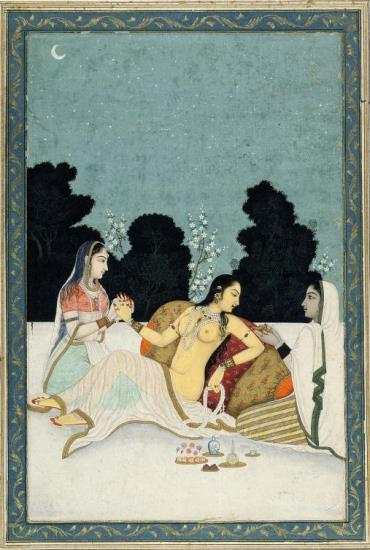
I enjoyed your comments on the recent post when I’ve asked you to match scents to a baroque Spanish still life. In my collection, I have a beautiful Mughal period miniature depicting a woman draped in jasmine. I couldn’t resist tossing it among–which fragrance would you pick to represent the mood of this painting.

As you can see, the lady has a bottle of perfume and a flask of rosewater in front of her.

Image by Bois de Jasmin

The Allure of Extrait de Parfum

If you were a medieval caliph and desired a fragrance to delight your senses, your royal perfumers would have mixed Tibetan musk with an equal amount of Yemeni ambergris and steeped the mixture in ben tree oil over a weak fire. They would have stirred it with a gold spoon and used a silver vessel to refine it further until the liquid itself turned golden and smelled like paradise itself. If you were the wife of the caliph Harun al-Rashid, the one of One Thousand and One Nights fame, then you would have asked for a touch of jasmine oil to remind you of Persian gardens in bloom. According to the 14th century Egyptian scholar Al-Nuwayri, such were indeed the refined tastes of his time.

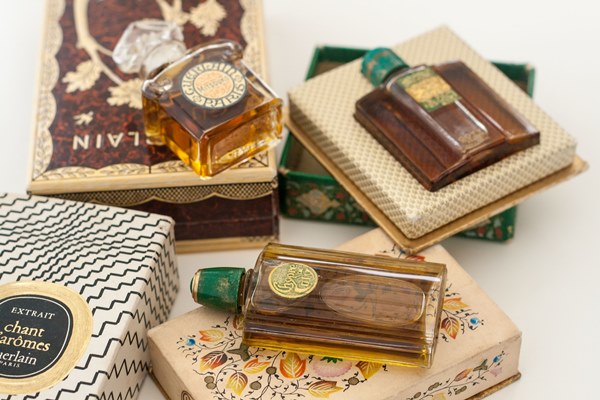
The luxurious, oil-based perfumes Al-Nuwayri describes in his book are the distant ancestors of the modern extrait de parfum. Today, the extrait de parfum is usually diluted in alcohol, but the proportion of fragrant oils in its formula is still sumptuously high. In my recent FT magazine column, The Allure of Extrait de Parfum, I describe what makes extrait de parfum different and why it still has a place in our perfume wardrobe.

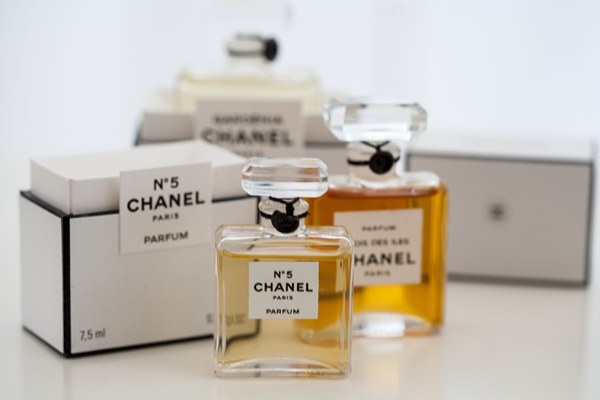
As I’ve noted in my article about perfume concentrations, the proportion of oil alone doesn’t matter as much as the ingredients themselves. However, the parfum, along with the Eau de Cologne, is the oldest way of enjoying fragrance. It was meant to be applied directly on skin, allowing it to envelop the wearer in a soft cloud of scent. For instance, the great classics like Chanel No 5, Guerlain Jicky or Caron Tabac Blond were created as such concentrated blends. Their lighter variations appeared later in the second half of the 20th century when atomizers became popular. To continue reading, please click here.

What are some of your favorite extrait de parfums?

Photography by Bois de Jasmin
Spanish Still Life : A Study of Jasmine and Fruit

I first saw this painting during an exhibition in Brussels devoted to Spanish still life art and it stayed in my memory. The artist behind it is Benito Espinós (1748-1818), whose still life floral arrangements are among the most dramatic and varied.


If you could match this painting to a perfume, what would you select?

Photography by Bois de Jasmin, detail, at the Spanish Still Life exhibit, Bozar.

The Olfactory Equivalent of a Souffle

Over dinner recently at Le Soufflé, a Paris restaurant specializing in the famed French dish, my friend asked me if there are any fragrances that suggest the same lightness and sensuality as this airy confection. The question took me by surprise, but I liked the idea of finding a floral scent that felt weightless without being fleeting. This was no simple task because the floral family is vast, ranging from fresh blends based on orange blossom and lily of the valley to smoldering potions of tuberose and jasmine.


In my recent FT column, The Olfactory Equivalent of a Soufflé, I take up the challenge and select three perfumes that capture the airy and decadent qualities of a soufflé.

The first fragrance I selected was Cartier’s Baiser Volé, a composition of white blossoms glazed with vanilla. Its green, sparkling opening includes rose, gardenia and white Casablanca lilies, while the sweetness is tempered by the cool touch of woods, subsiding in the drydown to musk and cedar. Despite its caressing, velvety impression, Baiser Volé retains its effervescent personality from the first to the last accord. To continue reading, please click here.

Image via FT

As Seen On

Design by cre8d
© Copyright 2005-2026 Bois de Jasmin. All rights reserved. Privacy Policy