Чай та османтус: Ароматна спадщина Китаю (українська версія)
When I traveled in Vietnam, I sat at a low wooden table in Hue and learned incense-making from a master. It rained outside and the scent of blooming osmanthus filled the studio with its languid fruity aroma. The master ground woods, resins, and spices before binding them into sticks with makko powder. The recipe, he explained, had Chinese origins: agarwood, sandalwood, clove, borneol. These were ingredients once carried along the great trade routes, linking temples, courts, and homes. Watching him, I realized how much of perfume’s history rests on such exchanges.
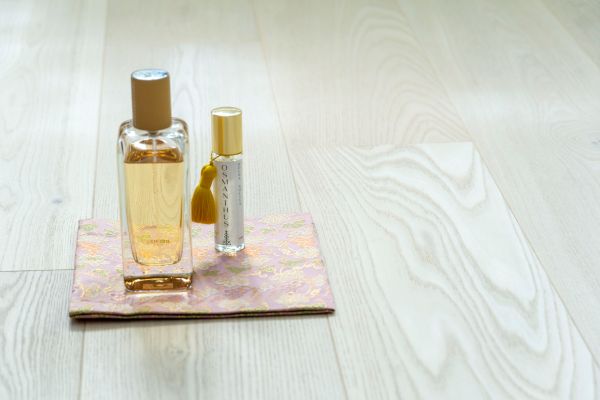
China’s scent culture is vast. It ranges from temple incense to osmanthus blossoms in autumn, from precious agarwood to the steam of a teacup. Western perfumery rarely bottles these traditions directly, but their influence lingers, shaping some of the most interesting fragrances of the last decades.
Incense and Agarwood
Incense — xiangdao, the “way of incense” — was already central in the Han dynasty, blending woods and spices for meditation and ritual. The most exalted ingredient was agarwood (chenxiang 沉香), praised in poetry and used in Buddhist temples.
Western perfumes echo this solemnity more than they replicate it. Armani Privé Bois d’Encens and Tauer Incense Extrême capture the charged stillness of smoke in air. For agarwood, most “oud” perfumes frame it through Arabic traditions, but a taste of the Chinese lineage can be glimpsed in artisanal distillations or in incense from houses like Shoyeido, which preserve recipes rooted in Chinese practice but interpreted in a Japanese manner.
Tea and Osmanthus
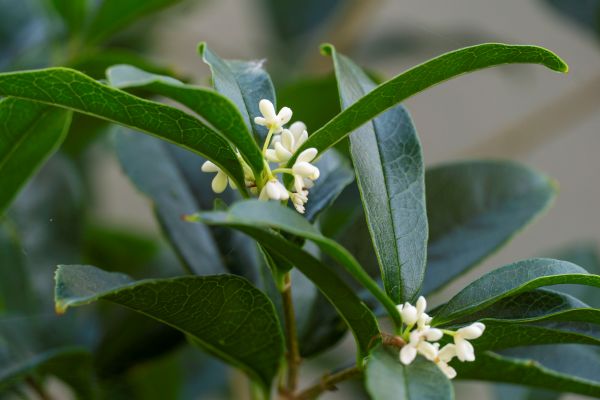
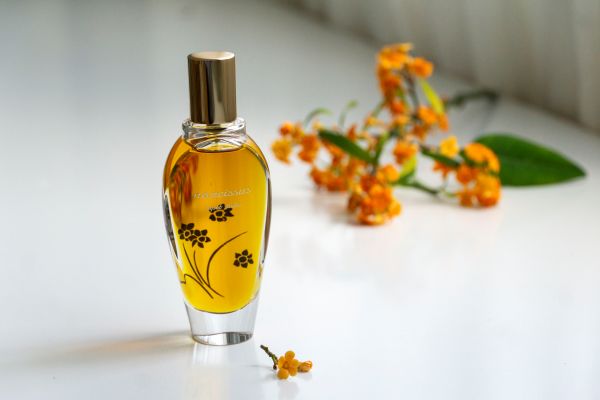
If incense belongs to temples, tea belongs to the everyday. Jean-Claude Ellena’s Bvlgari Eau Parfumée au Thé Vert drew on Chinese green tea, while Hermès Osmanthe Yunnan paired tea leaves with osmanthus blossoms from southern China. Osmanthus (桂花 guìhuā), with its apricot-jasmine perfume, scents autumn air in cities like Guilin and flavors wines, pastries, and teas. Perfumes such as The Different Company Osmanthus or Ormonde Jayne Osmanthus highlight these traditions with delicacy. Jo Malone’s Tea Collection explored Chinese varieties more directly: Silver Needle Tea (white tea, delicate and honeyed), Jade Leaf Tea (green pomelo, slightly bitter), and Midnight Black Tea (smoky vanilla). Each captures a different facet of tea.
Imagined China
Western perfumery often projects “China” through metaphors of jade, silk, or imperial gardens. Sometimes fanciful, sometimes respectful, these gestures nonetheless show a fascination with Chinese olfactory heritage. By Kilian Imperial Tea turns jasmine tea into a perfumed icon, while Pierre Guillaume Harmatan Noir frames the idea as an accord of green tea and jasmine. Ukrainian indie perfumer Sofiya Dolna made her osmanthus luscious and ripe, remarkably closed to how this note is interpreted in Asia.
The Golden Road and Beyond
As William Dalrymple writes in The Golden Road, exchanges between India and China carried not only goods but also ideas and scents. Spices from India enriched Chinese incense; Chinese aromatics reshaped tastes across Asia and Europe. When you recall that some of the most traded commodities along the Silk Road were incense and fragrant ingredients — musk, camphor, agarwood — it becomes clear that perfume, seen through this lens, is not an isolated art but a map of cultural encounters.
That map is still being drawn. Exhibitions like Notes Shanghai invite international perfumers and fragrance lovers to engage with Chinese heritage and reinterpret it for today. To encounter these scents in such a context is to realize that traditions are not fixed. They are conversations, unfolding across centuries and continents. When I travel to China later this fall, I plan to study the local artisanal market and meet the people who are weaving their traditions into something novel and original.
Exploring these perfumes through a cup of Yunnan tea, a scent of osmanthus cologne, a wisp of agarwood incense is to take part in that conversation. They are not just scents, but fragments of history carried along the Golden Road, still alive in the present.
Do you have your favorite fragrances inspired by Asian aromatics?
P.S. Besides Chinese artisanal perfumery, I also plan to learn more about Vietnamese perfumery. It’s a fascinating tradition in its own right. So stay tuned for more on this topic.

























33 Comments
Donna: How evocative to read, and, synchronistic as I finish up an incense-osmanthus perfume!
You have had so many wonderful aromatic experiences, Victoria. What a book that make! September 5, 2025 at 9:49am
Kaisa: Ah which perfume is that if I may ask? September 5, 2025 at 3:39pm
Donna: Oh, one I made. 🌝 September 5, 2025 at 4:16pm
Kaisa: Oh, how nice! September 6, 2025 at 3:49pm
Donna: Perks of being a perfumer.🙂 September 9, 2025 at 10:25am
Victoria: Thank you very much, Donna! I love the idea of a perfume with incense and osmanthus. September 8, 2025 at 7:20am
Anna: Such a lovely article! I love the discussion re the interpretation of different types of teas in perfume. Have you smelled the tea collection from One Day perfumes, a house from Hong Kong? There is an oolong, jasmine, and osmanthus – the oolong is a favorite, it manages to evoke the steam that rises from a hot cup of tea, right as you lower your lips to take a sip. September 5, 2025 at 9:54am
Victoria: Thank you. I have not yet tried One Day perfumes, but their tea collection sounds wonderful. I love the way you describe the oolong as steam rising from the cup, that is exactly the sensation a good tea perfume should evoke. September 8, 2025 at 7:28am
Alityke: My love for the jammy, apricot suede of Osmanthus knows no bounds. My first breath of Lutens Daim Blond changed my personal scented landscape. The axis tipped from my original love of old school chypres & spiced ambers, it now encompassed a wider golden horizon.
It sounds overly dramatic but whilst Ambre Sultan was my gateway to niche it was Daim Blond that threw off my hidebound shackles September 5, 2025 at 9:55am
Victoria: Not overly dramatic at all. Daim Blond really was a revelation for so many of us, showing how osmanthus could transform from a floral into something golden and complex. September 8, 2025 at 7:28am
Andy: I planted two different osmanthus bushes this spring, one orange-flowered and the other white. Though only marginally hardy, I’m hopeful they may acclimate to unpredictable Philadelphia winters. Both should start to bloom in about a month. In the meantime, Nicolaï Fig-Tea has been the best osmanthus perfume for me lately. The gauzy sillage reminds me of that surprising feeling when you smell osmanthus in the air on a walk, before you’ve spotted the flowers.
Diptyque Kimonanthe is another perfume that delights and surprises me, but it’s discontinued. It has an unusually direct camphor facet that I love. And then in its drydown, the balance and overlap of complimentary notes is so blended as to make it impossible to tell where the osmanthus ends, the leather begins, and where it gives way to agarwood and resins. It’s an experiential and creative perfume, and yet I find that it also manages to be pleasing and wearable. September 5, 2025 at 10:35am
Victoria: How exciting that you planted osmanthus. I hope they bloom well for you. Fig-Tea is a lovely choice, and I agree, Diptyque’s Kimonanthe was an extraordinary perfume, subtle yet daring. September 8, 2025 at 7:27am
Sariah: Osmanthus and tea are some of my favorite notes. I visited Japan in October and the hedges of osmanthus were intoxicating. I love TDC Osmanthus, Parfums d’Empire Osmanthus Interdit, and Les Indomedables Cuir de Chine. All 3 wear so beautifully on my skin. September 5, 2025 at 2:34pm
Kaisa: Lucky you! I was in Japan last year but I think it must have been just after the flowering season. May I ask you how TDC compares to the other two you mentioned? I love Cuir de Chine and found Osmanthus Interdit very nice (though a bit faint perhaps). September 5, 2025 at 3:52pm
Sariah: Cuir de Chine is very leathery, Interdit has some suede, and TDC maybe has a subtle suede note but very little. I find it the most floral of the three. It also has a lot of bergamot or some other citrus in the top. If you like Interdit for sure give it a try. It has a very different character than CdC which is much more intense. September 7, 2025 at 3:57pm
Kaisa: Thank you! September 8, 2025 at 1:42am
Victoria: You describe the differences beautifully. Osmanthus and tea together feel so natural, like two facets of the same idea. September 8, 2025 at 7:27am
Kaisa: Lovely article, thank you. Good tea is such a pleasure. I tend towards the black rather than the green, personally. The scent of incense in the forest temples in Nikko is one of my favourite scent memories of Japan from last year.
I never smelled real osmanthus (yet) but I’m looking for an osmanthus perfume with black tea facets that doesn’t remind me of fruity hampoo. Top pick so far is Cuir de Chine (tempted to buy), but I must absolutely try Daim Blond next time I’m in Paris. Tian Di by Frassai is rather lovely, on the fruity side but “dry”. I need to revisit Osmanthus Interdit and Osmanthe Yunnan.
Oh and I should mention, for those who are fans of green tea notes in perfumery, Salon d t by Angelos Creations Olfactives is lovely! September 5, 2025 at 3:49pm
Klaas: Kaisa, Olfactive Studio Smoky Soul (by Marc Antoine Corticchiato!) pairs osmanthus and black tea. I’ve never smelled it myself but if it’s anywhere near as good as the fragrances he makes for his own brand it should be deligtful!
Indigo Smoke by Calice Becker (another wonderful perfumer!) for Arquiste is very much Lapsang Souchong and apricot. So no osmanthus per se but it captures it’s fruity and leathery aspects beautifully. It’s very strong and very dense, so not for the faint of heart…… September 6, 2025 at 1:11pm
Kaisa: Thank you Klaas! I must try Smoky Soul as I’m a fan of Parfum d’Empire. Actually, MAC also just did a perfume called Osmanthus Noir for Parfumeurs du Monde, which I haven’t had a chance to sample yet.
I have a sample of Indigo Smoke that I put away to try it again in the autumn. September 6, 2025 at 3:47pm
Victoria: Smoky Soul sounds like something you would enjoy, especially paired with osmanthus. Indigo Smoke is dense, but it captures that apricot–tea idea perfectly, so revisiting it in cooler weather is a great idea. September 8, 2025 at 7:23am
Victoria: What a great set of suggestions. Indigo Smoke really does capture the lapsang tea feeling, and I like how you describe its density. September 8, 2025 at 7:26am
Klaas: Reading your blog all these years has given me the words to describe fragrance. You’re the best teacher ever! September 11, 2025 at 12:10pm
Victoria: You’re very kind! Thank you. September 12, 2025 at 1:01pm
Victoria: Thank you, I am glad you enjoyed it. Your memory of incense in Nikko is beautiful, that mix of nature and ritual is unforgettable. Daim Blond will be a wonderful next step. September 8, 2025 at 7:22am
Jennifer: Thank you for sharing this evocative article,Victoria. I have recently found a new company that creates the most amazing teas.~the company is CHAFOLIO. This afternoon the tea is Hibiscus Rose Tea.The scent and flavor is so incredible. It’s a small company with the family tea garden in China, and the tea is made in California by hand. September 5, 2025 at 5:09pm
Victoria: Hibiscus Rose tea sounds delicious, and what a wonderful company to discover. Thank you for sharing it, scent and flavor really do intertwine with memory. September 8, 2025 at 7:26am
Klaas: I love so many of the perfumes you mention, Victoria! Osmanthe Yunnan is a favorite, and Incense Extreme! The bottle I have is old and it’s becoming more and more delightful!
Most of the oudy fragrances I wear are inspired by the Middle Eastern scent profile I think, L’Oudh (again by Andy Tauer), Agar Ebene and Oud Alezan (both by Christine Nagel for Hermès) and Oudh Infini (Pissara Umavijani for her own brand Dustin. She is Thai I believe?)….
I’d be super curious to read your thoughts on the Chinese and Vietnamese ‘take’ on agar based perfumes!
Hinoki (Antoine Maisondieu for Comme des Garçons) is another fragrance I love! Very green and light, with its distinct cocktail of cypress, pine, camphor and hinoki wood! So quiet and contemplative…….it’s meditation in a bottle!!! Speaking of Asian heritage……. September 6, 2025 at 1:29pm
Klaas: Dustin = Dusita, of course! September 6, 2025 at 5:11pm
Victoria: Osmanthe Yunnan and Incense Extreme are treasures. Thank you for mentioning Hinoki, it really is meditation in a bottle. And yes, I plan to write more on how Chinese and Vietnamese perfumers interpret agarwood, it is a fascinating development. September 8, 2025 at 7:26am
Aurora: What an amazing article and it taught me things, I had to look up borneol.
Osmanthus became a favorite note when I smelled Daim Blond, and one favorite layering is DB+l’Agent. I also like an obscure Lush perfume Secret Garden. September 7, 2025 at 4:06pm
Victoria: Thank you. Daim Blond was also my introduction to osmanthus, and I agree, it captures the note’s opulence so well. Your layering with L’Agent sounds fascinating, a dark and plush pairing. September 8, 2025 at 7:24am
mithun gowda: Such a beautifully told story. The way you describe the incense-making process and its cultural roots makes the journey feel vivid and meaningful. It’s amazing how fragrance carries so much history within it. November 19, 2025 at 11:27pm